


Paver Walkway Installation Cost: 2025 Ultimate Guide
Understanding the Paver Walkway Installation Cost
Figuring out the paver walkway installation cost is a key step for any homeowner. You’re looking to improve your outdoor space, and understanding the budget upfront helps immensely.
For a quick answer, here’s what you can expect:
- The national average cost to install a paver walkway is around $2,665.
- Typical prices often range from $1,500 to $4,000, including both labor and materials.
- Per square foot, you’ll generally pay between $9 and $20.
- That complex designs or challenging site conditions can push the total cost much higher, potentially reaching $8,000 or more.
Please note: These are average costs based on broad internet data and not actual costs for OutdoorX LLC. Your specific project’s cost will depend on many unique factors.
A paver walkway isn’t just a path; it’s a significant upgrade that adds curb appeal and value to your home. While it’s an investment, pavers are known for their durability and long lifespan, often lasting 50 to 100 years. This makes them a worthwhile long-term addition.
The final price tag depends on several things: the type of pavers you pick, how complex your design is, the labor involved, and even the unique conditions of your property. In the sections below, we’ll break down these factors so you can better understand your budget.
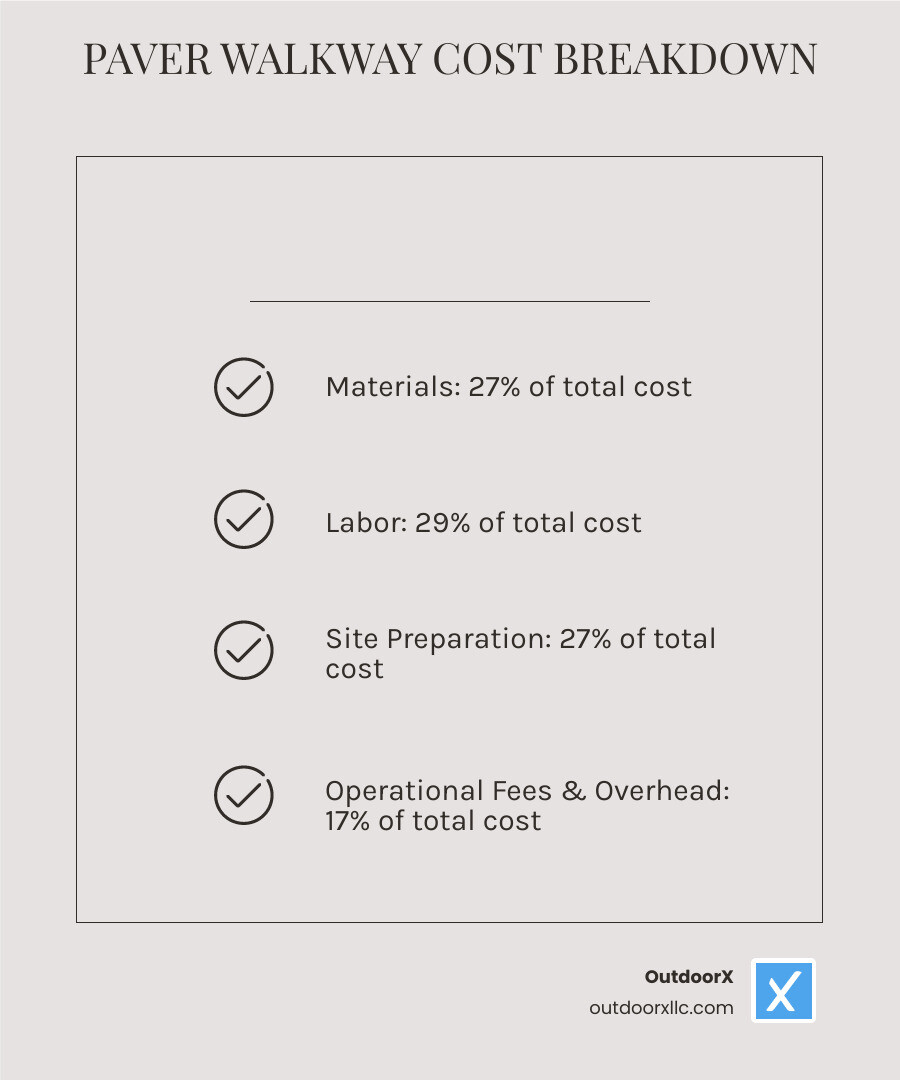
Paver walkway installation cost terms to remember:
Deconstructing the Paver Walkway Installation Cost
All figures in this article are national internet averages (not OutdoorX’s own pricing) but they give you a realistic starting point when planning in Essex County, MA (Andover, Newburyport, Beverly, etc.). Your final investment depends on four main inputs:
- Project scope & design – total square footage and pattern details
- Current site conditions – slope, soil, access, and any demolition work
- Material choices – concrete, brick, natural stone, permeable systems, and their quality grades
- Labor rates – which vary by contractor skill and local market
Our Hardscaping Services cover the entire process from design to final cleanup.

1. Labor & Contractor Experience
Labor is normally the largest line item. Online sources show professional installers charging $55-$75 per hour or $6-$11 per sq ft for straightforward work. Elaborate inlays, curves, or tight access can push labor well above those averages.
Why the range?
- Seasoned crews work faster and reduce mistakes
- Fully insured & licensed firms carry higher overhead
- Urban North-Shore rates trend higher than rural markets
2. Paver Materials
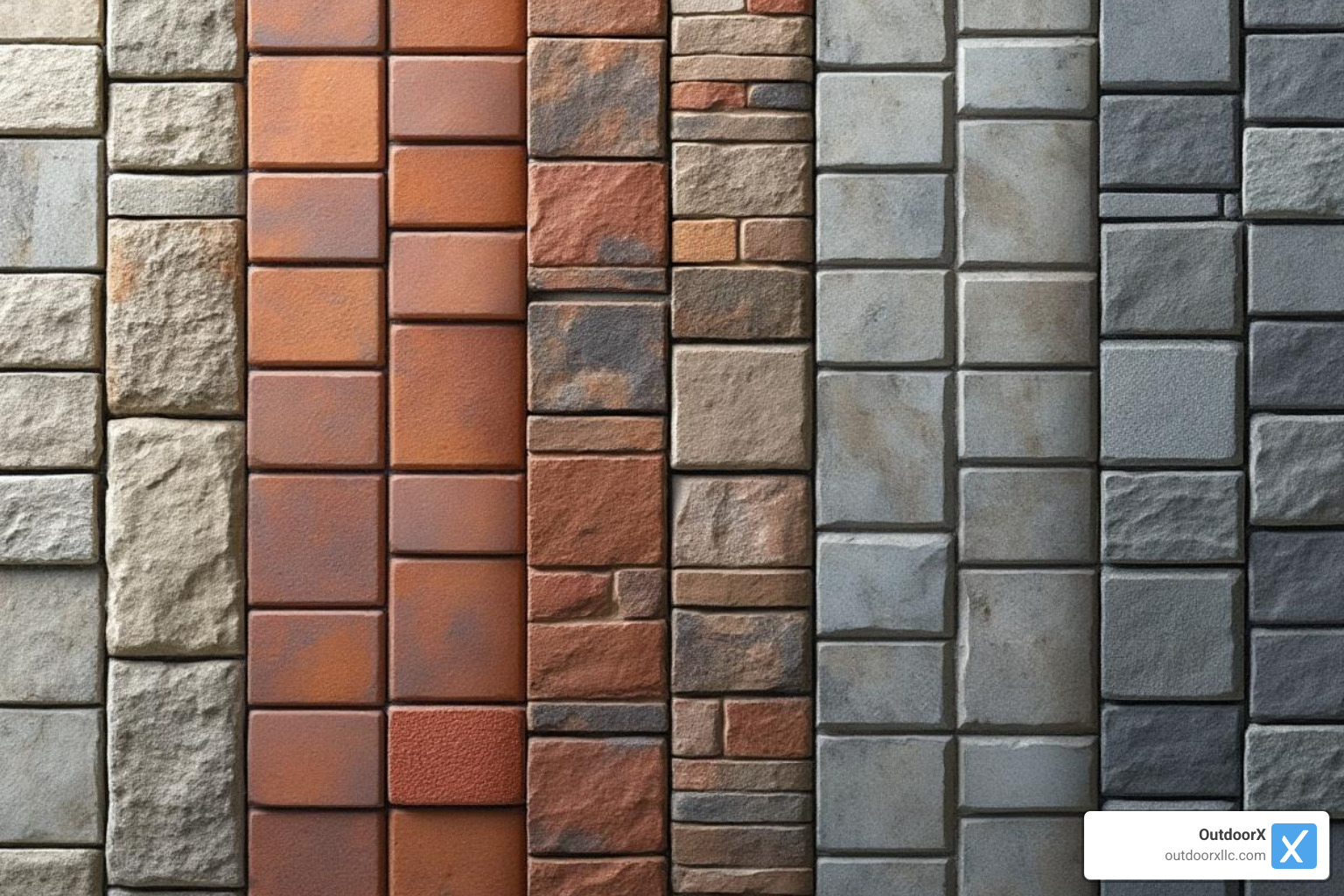
Average installed cost per square foot (wide ranges reflect economy vs. premium grades):
- Concrete pavers: $8 – $25
- Clay brick pavers: $10 – $30
- Natural stone (bluestone, granite, slate, travertine): $12 – $50+
- Permeable systems: typically 15-25% more because of the deeper aggregate base
Plan on 10-20 % extra material for cuts and breakage.
3. Size & Design Complexity
Nationally, paver walkways average about $14.50 per sq ft.
- An 80 sq ft straight path is approximately $1,100-$1,600.
- A 280 sq ft serpentine walk with borders could top $4,000.
Curves, herringbone, borders, or color blends add $2-$5 per sq ft in extra layout time, cutting, and waste.
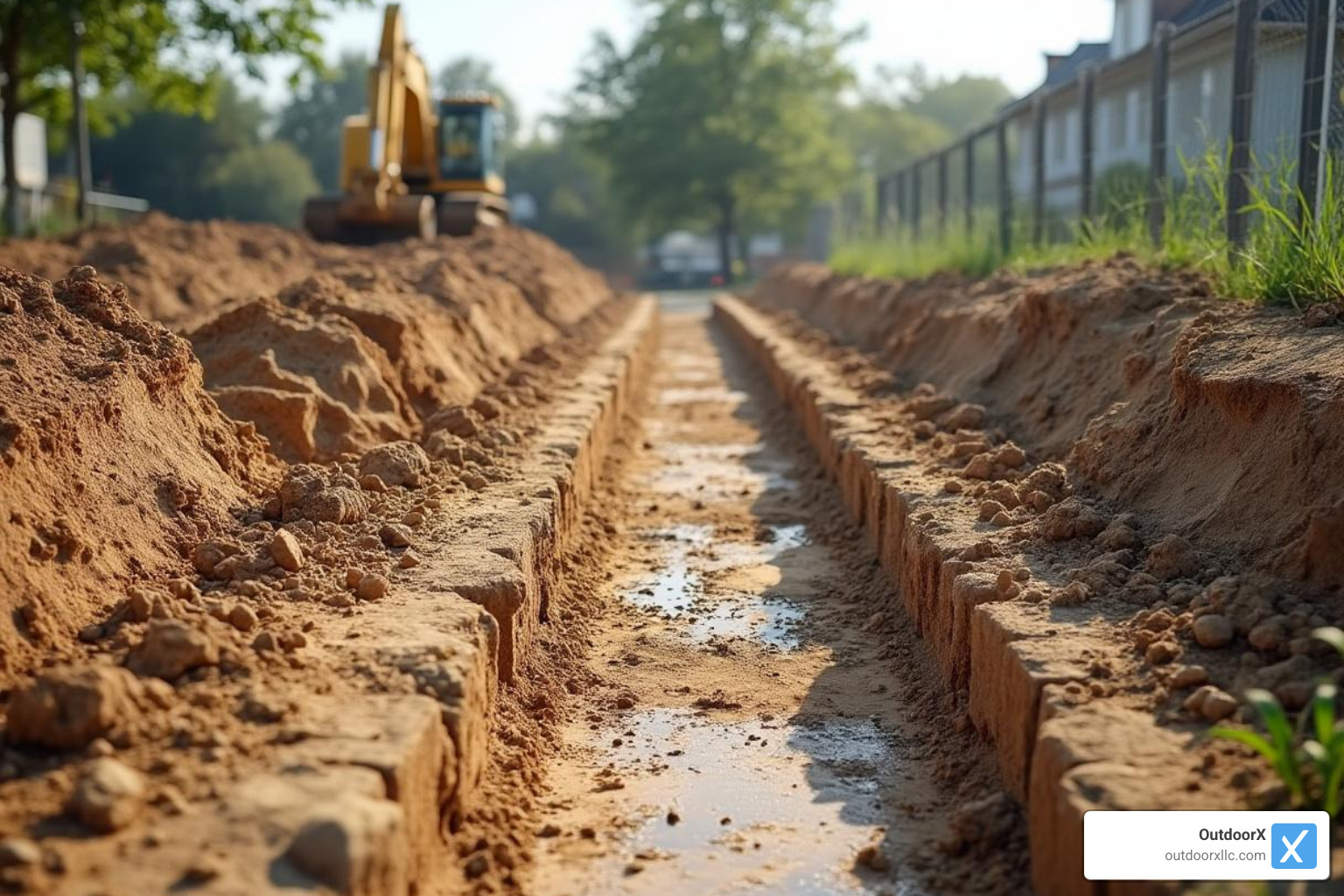
4. Site Preparation
Proper sub-base is non-negotiable. According to industry leaders like the Concrete Masonry & Hardscapes Association (CMHA), a solid base is the key to a long-lasting installation.
- Excavation depth: 6-8 in. for walkways; 10 in.+ for permeable installs
- Grading: $0.08-$2 per sq ft depending on re-sloping needs
- Demolition: removing old concrete/asphalt can add $0.30-$0.50 per sq ft
- Tight access: wheel-barrowing materials can tack on $1-$2 per sq ft
5. Operational Overhead
Expect 10-22 % of any professional quote to cover essentials such as dump fees, fuel, equipment maintenance, insurance, permitting ($200-$1,000+), and a fair profit margin that keeps a reputable company in business.
6. Optional Upgrades
- Landscape lighting: $50-$150 per fixture
- Steps or small retaining walls: $40-$345 per linear foot
- Sealing or staining: $0.75-$4 per sq ft
- Heated walkway: roughly $12 per sq ft
Visit our Landscape Design & Build page for ideas on marrying budget with beauty.
Professional vs. DIY Installation: A Cost and Effort Comparison
Should you tackle the project yourself or let a pro handle it? Here’s a concise side-by-side look.
| Professional Crew | DIY Homeowner | |
|---|---|---|
| Typical all-in cost* | $9 – $20 per sq ft | $4 – $12 per sq ft (materials + tool rental) |
| Time investment | 1-3 days for average walk | Several weekends + learning curve |
| Tools required | Contractor-grade compactor, saws (no purchase required) | Purchase/rent tamper, plate compactor, masonry saw, safety gear |
| Quality / longevity | Installed on laser-level base, warrantied | Depends on your skill; mistakes can lead to settling or drainage issues |
| Warranty | Labor & manufacturer coverage | None |
*All pricing reflects broad internet averages, not OutdoorX quotes.
The Hidden Costs of DIY
- Tool rental/purchase: Plate compactor ($70-$250 per day), masonry saw ($65-$120), plus small hand tools.
- Extra materials: Over-buying to account for breakage and mis-cuts.
- Physical labor: Excavation, hauling gravel & sand, and precise leveling are demanding.
- Risk factor: A base that isn’t compacted to 95 % density or slopes the wrong way can mean costly re-work.
For many homeowners, the apparent DIY savings disappear once time, rentals, and potential repairs are tallied.
The Value of Hiring OutdoorX
- Expert crews & equipment finish faster with minimal disruption.
- Design guidance ensures the right pattern, color, and border for your property.
- Proper prep & drainage deliver a walkway that lasts 50-100 years.
- Warranty support means peace of mind.
Ready to outsource the heavy lifting? Explore our Hardscaping Services in Beverly, MA and throughout Essex County.
Long-Term Value: Pavers vs. Other Walkway Materials
When you’re thinking about your paver walkway installation cost, it’s easy to just look at the upfront price tag. But hold on a second! A smart homeowner knows that the real value comes from how well something lasts, how much it adds to your home’s curb appeal, and what kind of return on investment (ROI) you’ll see down the road.
Pavers aren’t just pretty; they’re a long-term investment that often outperforms other walkway materials. We’re all about creating outdoor spaces that aren’t just beautiful today, but for decades to come. Want more ideas? Explore our More Outdoor Patio Tile Ideas.
Pavers vs. Poured Concrete
Let’s talk about the classic showdown: pavers versus poured concrete. Many homeowners first lean towards concrete because of its seemingly lower initial paver walkway installation cost. Nationally, poured concrete might cost you anywhere from $6 to $12 per square foot to install. Compare that to paver walkways, which can be $9 to $20 per square foot.
But here’s the catch: repairability. If a concrete walkway cracks – and they often do, thanks to shifting ground or harsh weather – you’re usually looking at demolishing and re-pouring a whole section, or even the entire slab. That’s a big, messy, and expensive job! With pavers, it’s a different story. If one paver gets damaged, we can simply pop it out and replace just that single unit. Easy peasy, and much kinder to your wallet.
Then there’s the lifespan and cracking issue. Concrete is notorious for cracking, especially with our New England freeze-thaw cycles. Once a crack starts, it loves to spread. Pavers are like a flexible puzzle. Each individual paver can shift ever so slightly with the ground, making them incredibly resistant to cracking. A properly installed paver walkway can literally last 50 to 100 years with very little fuss.
And finally, aesthetic options. Concrete, unless it’s specially stamped or stained (which adds to the cost), looks pretty plain. Pavers, though? Oh, the possibilities! You get a huge variety of shapes, sizes, colors, and textures. You can mimic natural stone, classic brick, or even wood. This means a paver walkway can truly lift your home’s curb appeal and match your unique style.
Pavers vs. Gravel or Stepping Stones
Now, let’s look at the other end of the spectrum: gravel and stepping stones. These are definitely the most budget-friendly upfront, with gravel costing as little as $1 to $3 per square foot for materials. Stepping stones fall somewhere in between, depending on what kind you choose.
However, consider stability and safety. Gravel can be a real pain! It shifts underfoot, making it uneven and tricky to walk on, especially if you’re wearing heels or have mobility challenges. Stepping stones can also become wobbly or slippery over time. Pavers, on the other hand, are installed on a carefully prepared, compacted base. This gives you a wonderfully stable, even, and safe surface for everyone.
And what about maintenance requirements? Gravel walkways need constant raking to keep them neat, and weeds absolutely love to sprout through them. Stepping stones might need re-leveling now and then. Paver walkways are much lower maintenance. A simple sweep is usually all it takes, and with polymeric sand, those pesky weeds are kept largely at bay.
When it comes to longevity, gravel and stepping stones will need more frequent top-ups or adjustments as they get displaced or settle. But pavers? As we mentioned, they’re built to last for many, many decades with proper care. They’re a true long-term solution.
Finally, the overall appearance. While gravel can give a rustic vibe and stepping stones a natural touch, pavers deliver a far more polished, refined, and intentional look. They truly boost your home’s curb appeal and add significant property value. It’s about making a statement!
Frequently Asked Questions about Paver Walkways
It’s natural to have questions when planning a big home improvement project! Here at OutdoorX, we often hear similar inquiries from homeowners across our service areas, from South Hamilton to Manchester-by-the-Sea. You’re thinking about investing in a beautiful paver walkway, and you want to make sure you’re making the best choices. Let’s explore some of the most common questions we get.
How long does a professionally installed paver walkway last?
This is one of our favorite questions because the answer is truly impressive! When you invest in a professionally installed paver walkway, you’re building something designed to stand the test of time. With just minimal routine maintenance, you can expect your new paver walkway to last an incredible 50 to 100 years. Yes, you read that right — it’s a home improvement that can literally last for generations!
This incredible longevity is a huge part of why the initial paver walkway installation cost is such a worthwhile investment. The secret lies in the way pavers are designed. Unlike a rigid concrete slab that’s prone to cracking with ground movement or freeze-thaw cycles, individual pavers interlock.
This allows for slight, flexible movement with the ground, preventing those unsightly cracks. To help maximize this already impressive lifespan, we often recommend periodic sealing of your pavers. This extra step helps protect them from stains, fading due to UV rays, and general wear and tear. Plus, if one paver ever gets damaged, it’s a breeze to remove just that single unit and replace it, keeping your walkway looking perfect for decades to come.
Is it cheaper to lay concrete or use pavers for a walkway?
Ah, the classic cost comparison! When you’re looking at the upfront paver walkway installation cost versus poured concrete, it’s true that concrete generally appears cheaper initially. For instance, poured concrete walkways typically cost between $6 and $12 per square foot to install. Paver walkways, on the other hand, usually range from $9 to $20 per square foot.
But here’s the catch: “cheaper” upfront doesn’t always mean “more cost-effective” in the long run. While concrete has a lower material cost and might seem like less labor, it has a significant weakness: it loves to crack! Especially in climates like Massachusetts, with our distinct freeze-thaw cycles, concrete is very susceptible to cracking. Once a crack appears in concrete, it’s difficult and often very expensive to repair. You usually have to demolish and re-pour entire sections, which can be a huge hassle and cost.
Pavers, despite their slightly higher initial investment, offer fantastic long-term savings. Their inherent flexibility means they resist cracking beautifully. And if a paver does get damaged (maybe you drop something heavy, or a tree root causes an issue), it’s a simple, inexpensive fix to remove just that single paver and replace it.
This ease of repair, combined with their superior durability and stunning aesthetic appeal, often makes pavers the more economical choice over the entire lifespan of your walkway. Plus, the curb appeal and value they add to your home often provide a much better return on investment than a plain concrete slab.
Do I need a permit to install a paver walkway in Massachusetts?
This is a really important question, and the answer is usually: it depends! The requirement for a permit to install a paver walkway in Massachusetts can vary quite a bit from town to town, and it also depends on the specific details of your project. There isn’t one universal statewide rule that covers every single situation.
Generally speaking, you might need a permit if your project falls into certain categories. For example, if your new walkway will connect to a public sidewalk or street, or if it involves significant excavation or grading that could impact the drainage on your property (or even your neighbors’ properties), a permit is often required. Some towns also have regulations about the total impervious surface area on your property, which is the amount of hard, non-draining surface.
Adding a large walkway could push you over that limit, requiring a permit to manage stormwater runoff. And, of course, if your project involves any changes to existing structures or utility lines, that will almost certainly trigger a permit requirement.
So, while a small, simple garden path entirely within your private property might not need a permit in some towns, a larger, new front walkway that changes drainage patterns or connects to a municipal sidewalk almost certainly will. Permit costs can also vary widely, from around $200 to $1,000 or even more.
The most crucial step is to check directly with your local building department in your specific town (whether you’re in Danvers, Topsfield, Wenham, or any of the other towns in Essex County we serve) before you start any work. They’ll have the most accurate and up-to-date information on local regulations, what permits you’ll need, and any inspections required for your paver walkway project. Don’t worry, we can definitely help guide you through this process during our consultation!
Conclusion: Paving the Way for Your New Walkway
Well, we’ve walked through a lot together, haven’t we? Understanding the paver walkway installation cost might seem like a big puzzle at first. But as we’ve explored, it really comes down to a few key pieces. Things like the type of pavers you love, the size and unique design you envision, the conditions of your property, and, of course, the skilled hands of the professionals who bring it all to life.
While there’s certainly an investment involved upfront, think of it as laying the groundwork for something truly special. The long-term benefits of a paver walkway are just fantastic. They’re incredibly durable, easy to repair if a piece ever gets damaged, and they add a timeless beauty that other materials just can’t match. When you compare them to concrete, gravel, or even stepping stones, pavers truly stand out as a superior choice.
In short, a paver walkway isn’t just a simple path; it’s a valuable home improvement project. It really boosts your home’s curb appeal and promises enjoyment for many, many decades.
For all you homeowners in Essex County, MA, looking for top-notch craftsmanship and solutions custom just for you, OutdoorX is here. We love bringing visions to life! Our team specializes in custom design and installation, making sure your paver walkway is not only stunning but also perfectly fits your home and how you live.
Ready to start paving the way to a more beautiful and functional landscape? We’d love to chat. Get a professional consultation for your hardscaping project with OutdoorX today. Let’s create something amazing together!
