


Patio Paver Installation: Flawless 2025 Mastery
Why Choose Pavers for Your Outdoor Space?
Many homeowners dream of a beautiful outdoor living space. The good news is that patio paver installation offers a durable, attractive, and functional solution that can truly transform your backyard. Unlike poured concrete, pavers rarely crack, are easy to repair, and give you endless design options.
Imagine stepping out onto a stunning patio perfect for morning coffee or a summer barbecue. Pavers provide a flexible surface that can withstand the elements and heavy use for years.
Here are the essential steps for a successful patio paver installation:
- Plan Your Layout: Measure your area, sketch your design, and choose your pavers.
- Prepare the Site: Mark the area, excavate the soil, and ensure proper drainage.
- Build the Base: Lay and thoroughly compact a gravel or crushed stone base.
- Add Bedding Sand: Spread a precise layer of sand for leveling.
- Lay Pavers: Place each paver carefully in your chosen pattern.
- Install Edge Restraints: Secure the perimeter to keep pavers in place.
- Fill Joints: Sweep sand (often polymeric) into the gaps between pavers.
- Final Compaction: Compact the entire surface to lock everything down.
Ready to see how a solid paver patio is built?
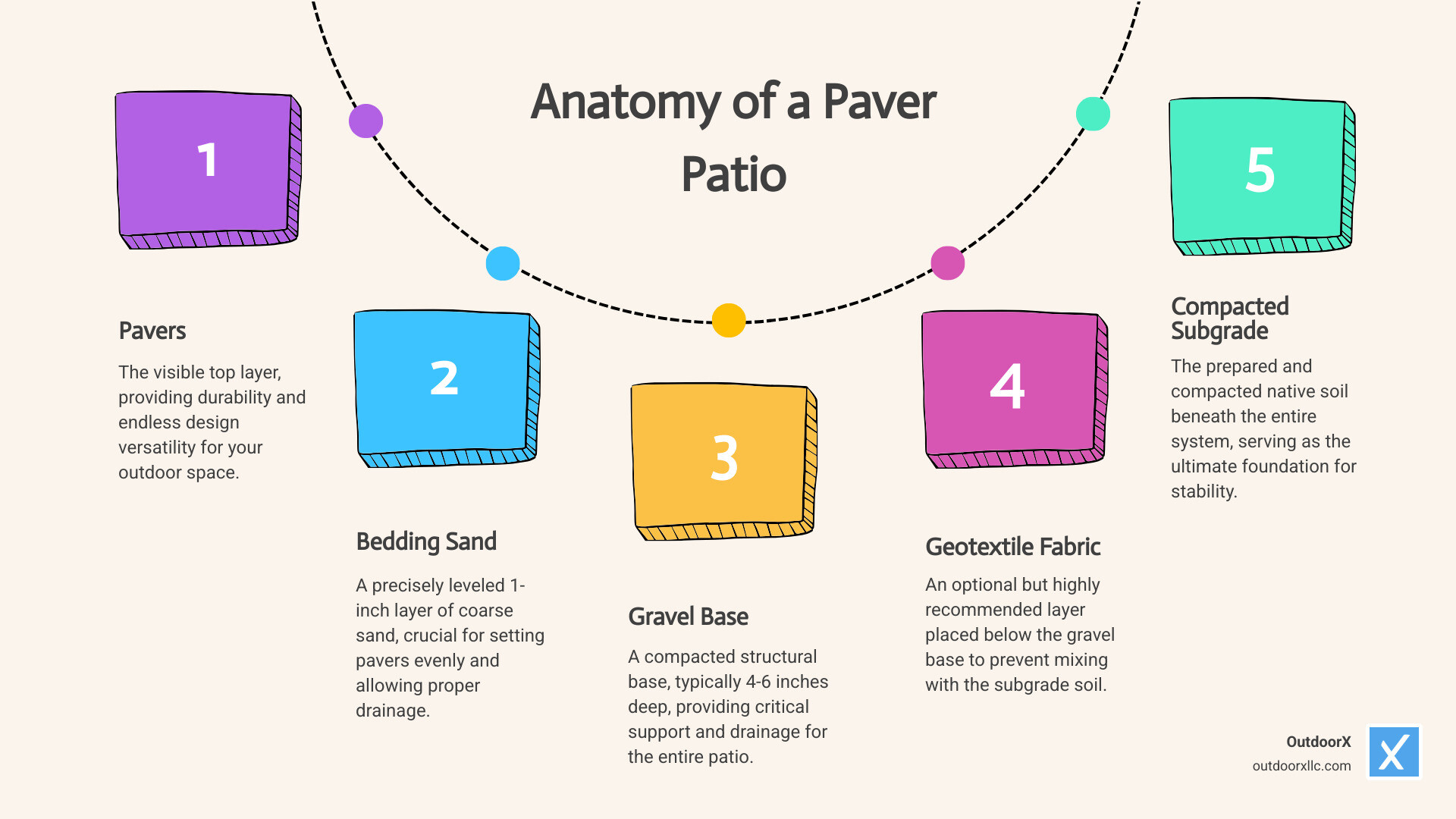
Find more about patio paver installation:
Step 1: Planning and Preparation for Your Paver Project
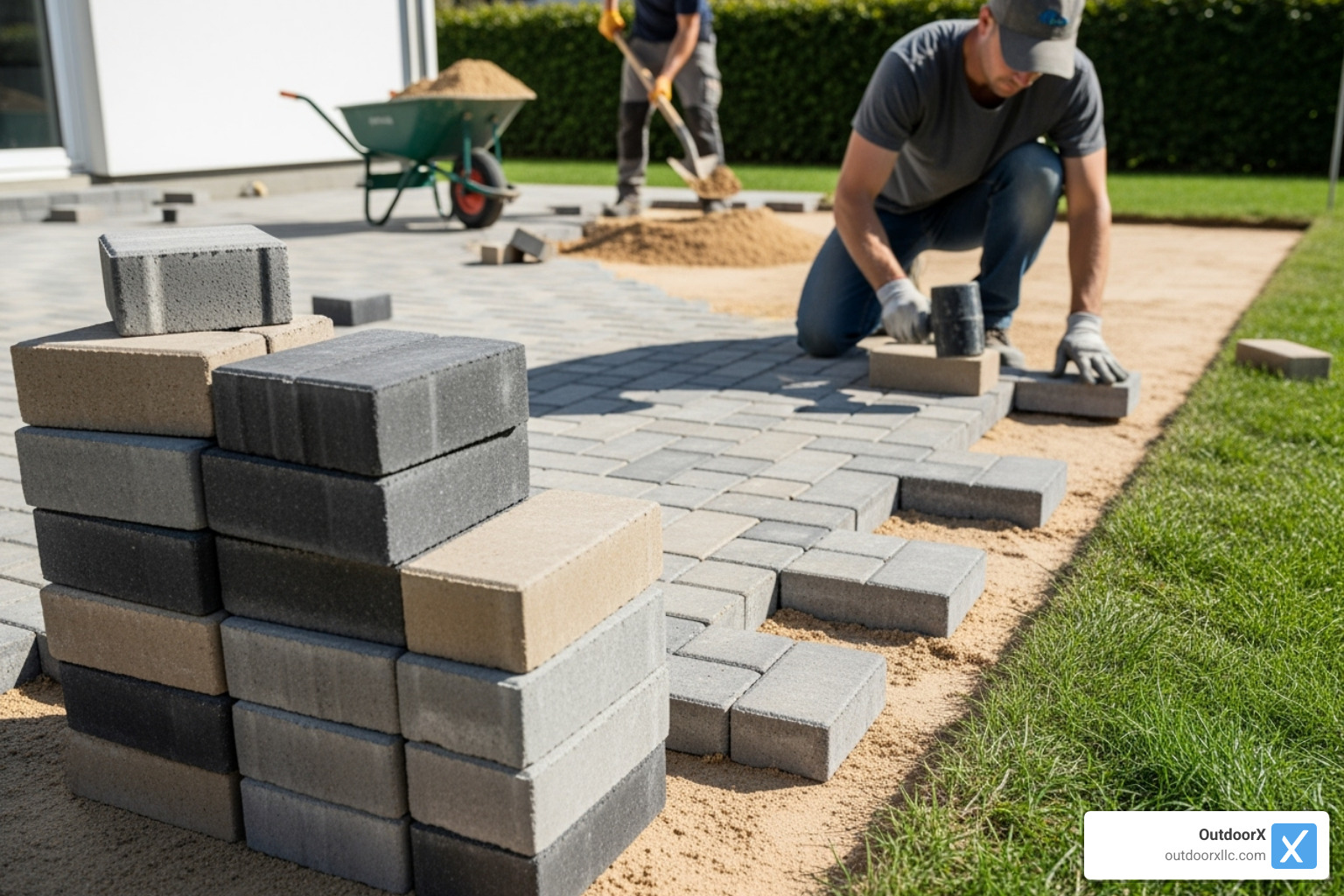
A successful patio paver installation begins with meticulous planning. This stage is the blueprint for your outdoor dream, covering everything from the overall look to the specific materials and tools. It’s also the time to check local building codes for compliance. A vital safety tip: always call 811 a few days before you dig. This free service locates underground utilities, preventing costly and dangerous accidents. These early steps make all the difference.
Designing Your Patio: Size, Shape, and Patterns
First, sketch your dream patio. Ask yourself how you’ll use it: for cozy reading, entertaining, or as a foundation for a hot tub or grill? For heavy objects, use thicker paving stones for long-term stability.
Key design considerations include ensuring the patio is large enough for furniture and comfortable foot traffic. Also, consider the view from your windows and doors when choosing the location.
Next, consider paver patterns, which give your patio its unique character. A classic running bond features parallel rows offset by half a paver’s length. The zigzag herringbone pattern is dynamic and strong, great for any area. The basketweave pattern alternates pairs of pavers horizontally and vertically for a woven look. For a unique effect, the pinwheel pattern uses a central square paver surrounded by rectangular ones.
Finally, choose your paver materials. Concrete pavers are versatile, budget-friendly, and come in many colors, shapes, and textures. Brick pavers offer a timeless, classic look. For elegance, natural stone pavers like bluestone, granite, or travertine provide unique beauty, though they are a larger investment.
More info about our landscape design services
Calculating Materials: Pavers, Gravel, and Sand
Accurate material calculation is crucial to avoid multiple trips to the supply store. We recommend buying extra hardscape materials to account for cutting errors or future repairs. It’s better to have too much than not enough.
First, determine the square footage of your patio by multiplying its width and length. For example, a 16-foot by 18-foot patio is 288 square feet.
To calculate paver quantity, find out how many pavers cover one square foot (your supplier can provide this). For 4×8 inch pavers, you’d need about 4.5 per square foot. For a 288 sq ft patio, that’s roughly 1,296 pavers. Always add 5-10% extra for cuts and waste.
For the gravel base, aim for a 4-6 inch compacted layer for patios. For driveways, double that to 8-12 inches. To calculate cubic feet of gravel, multiply your patio’s square footage by 1/3 for a 4-inch base. A 288 sq ft patio needs about 96 cubic feet of gravel.
For the sand bed, you’ll need a 1-inch layer, which is typically 1/3 the amount of gravel in cubic feet. For our example, that’s about 32 cubic feet of sand.
How to Lay Pavers: Installing Pavers for a DIY Patio
Gathering Essential Tools and Materials
Gathering all tools and materials beforehand makes the paver project smoother. Larger tools can be rented to save money and storage space.
You’ll need a shovel (round-point and flat-blade), wheelbarrow, tape measure, a long level (4-foot+), line level, stakes and string line for layout and slope, and a rubber mallet for setting pavers.
The most crucial rental is a plate compactor for compacting the base and setting pavers. For cutting, you’ll need a masonry saw or paver splitter. A screed board (a straight 2×4) and PVC pipes or electrical conduit help level the sand bed. Also, gather a broom, and always use safety glasses and gloves.
For materials, you’ll need your chosen pavers, crushed stone aggregate (gravel) for the base, and coarse bedding sand for the leveling layer. You’ll also need edge restraints to keep pavers in place and polymeric sand for filling the joints. An optional but highly recommended geotextile fabric acts as a barrier between the subsoil and your base, preventing mixing and helping with weed control.
Step 2: The Foundation – A Guide to Proper Patio Paver Installation
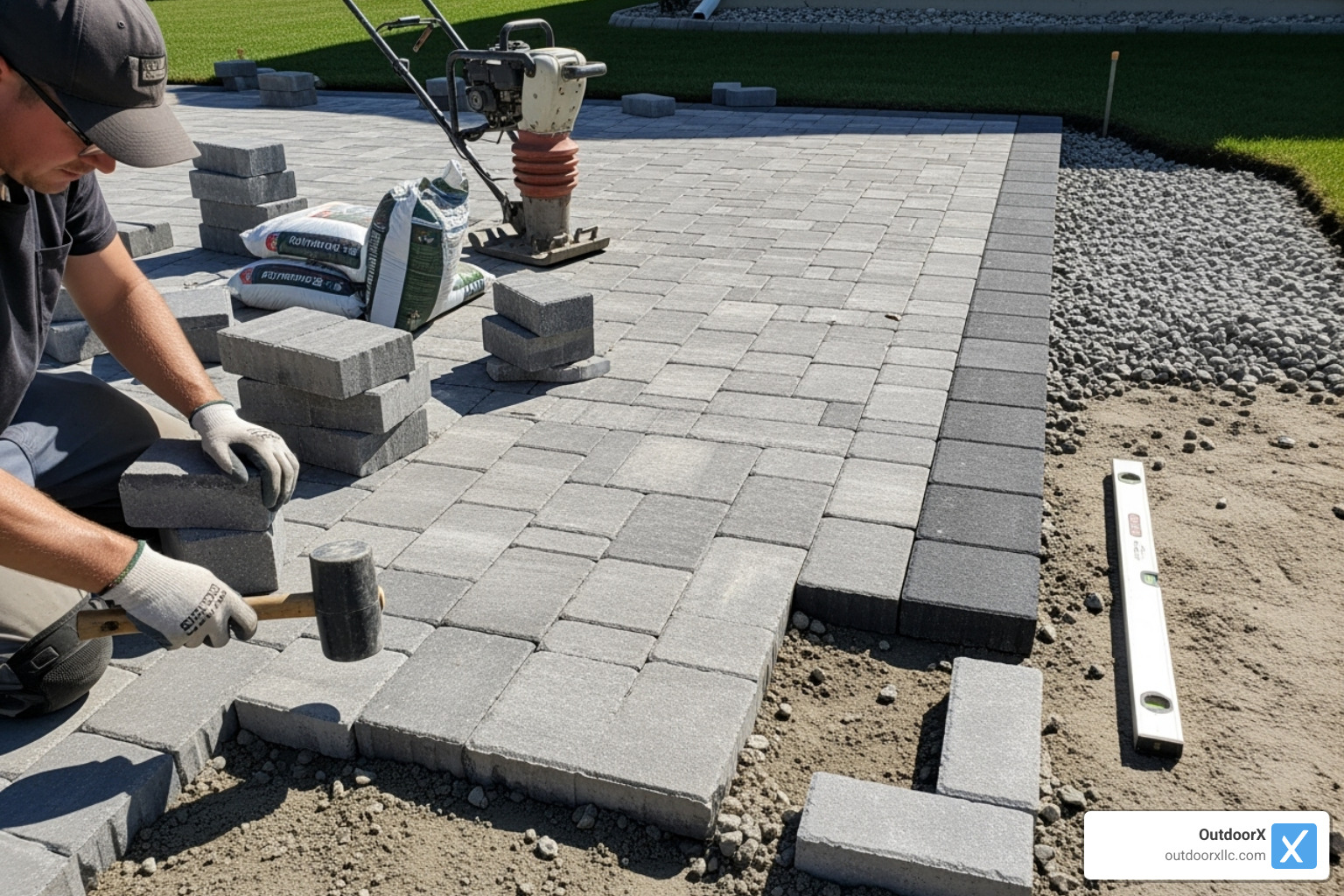
With your design and materials ready, it’s time to build the foundation. This step is the backbone of your patio, ensuring your patio paver installation stands the test of time by preventing shifting pavers or puddles. It’s the groundwork for your outdoor sanctuary.
Preparing the Site: Excavation and Grading
First, mark your patio’s perimeter with stakes and string line. For perfect 90-degree corners, use the 3-4-5 triangle method: measure 3 feet along one line and 4 feet along the perpendicular line; the diagonal between these points should be exactly 5 feet.
Next, excavate the area. For patios and walkways, dig 6-8 inches deep, plus the paver thickness. For driveways, go deeper: 10-12 inches plus paver thickness. Remember to call 811 before digging to avoid hitting any underground utility lines.
A crucial part of site prep is creating a proper drainage slope away from your home. Aim for a gentle incline of about 1 inch for every 8 feet (a 1.5-2% slope). This ensures rainwater flows away from your home’s foundation, preventing puddles. Use string lines and a line level to set the slope as you dig. You can learn more about proper drainage here: French drain around patio.
Once you’ve dug to the correct depth and established your slope, remove any grass and roots. Then, use a plate compactor to compact the exposed subsoil. Proper soil compaction at this stage is essential for a long-lasting paver patio.
Building a Solid Base with Gravel and Sand
With your site excavated and compacted, you’re ready to build the robust base that will support your pavers.
We highly recommend laying geotextile fabric over the compacted subsoil. This permeable barrier prevents the base material from mixing with the soil, which improves stability and helps prevent weeds.
Next, add crushed stone or gravel to a depth of 4-6 inches. Spread and compact it in 2-inch layers (lifts) using a plate compactor. Make several passes over each lift, misting with water to aid compaction. A well-compacted base is incredibly stable and provides a firm foundation.
Once your gravel base is compacted and sloped correctly, spread a 1-inch layer of coarse sand over it. This sand layer cushions the pavers and allows for fine-leveling adjustments.
To create a perfectly flat sand bed, use screed rails (1-inch diameter PVC pipes). Lay two parallel pipes on the gravel base, pour sand between them, and use a straight 2×4 (your screed board) to drag across the pipes, leveling the sand. Carefully remove the pipes and fill in the voids. Do not compact this sand layer; it must remain loose for the pavers to settle into place.
Step 3: The Art of Laying Pavers and Finishing Touches

After careful preparation, it’s time to lay the pavers. This is where your patio paver installation transforms into a stunning outdoor space, and where patience and attention to detail pay off.
Best Practices for Laying Pavers
For a professional look, start from a 90-degree corner or a fixed edge like the house foundation. This provides a crucial straight line to work from, ensuring proper alignment.
When laying each paver, place it straight down into the sand bed. Do not slide, drag, or stomp it into place, as this will disturb the smooth sand layer underneath.
Maintaining consistent joint spacing is key. Most quality pavers have built-in spacer bars that create the perfect 1/8-inch gaps needed for the jointing sand.
Every few rows, run a string line across your work to check alignment. If a paver needs adjusting, a gentle nudge with a screwdriver is more effective than hammering it.
Finally, give each paver a gentle tap with a rubber mallet to settle it firmly into the sand bed, creating a solid, even surface.
Cutting Pavers and Installing Edge Restraints
Inevitably, you’ll need to cut some pavers to fit around edges. The key is to measure and mark pavers precisely before cutting. Remember the rule: “measure twice, cut once.”
For clean cuts, use a masonry saw or splitter. A wet saw with a diamond blade provides the cleanest cuts with minimal dust. Safety gear is non-negotiable: always wear safety glasses, hearing protection, and a dust mask.
Installing edge restraints is critical but often overlooked. These are the unsung heroes of a lasting patio. Without them, pavers will eventually shift, creating gaps and an uneven surface.
Install the edge restraints snugly against the outermost pavers and secure them with spikes driven deep into the compacted gravel base every 12 to 18 inches. For curves, use flexible edge restraints.
Locking Pavers with Jointing Sand
The final step to lock your patio paver installation together is sweeping polymeric sand into the joints. This sand contains binding agents that create a semi-rigid joint when activated with water.
Spread the sand generously across the surface, working it deep into every gap with a stiff broom until the joints are completely filled.
Next, use your plate compactor to settle the pavers and vibrate the sand deeper into the joints. Make multiple passes to ensure everything is locked tight and level. Add more sand if needed.
Before the final step, remove all excess sand from the paver surfaces. Following the manufacturer’s instructions, mist the entire patio with water to activate the binding agents. Use a gentle spray—too much water can wash the sand out. Within hours, the joints will harden into a durable, weed-resistant seal.
Step 4: Paver Maintenance and When to Call a Professional
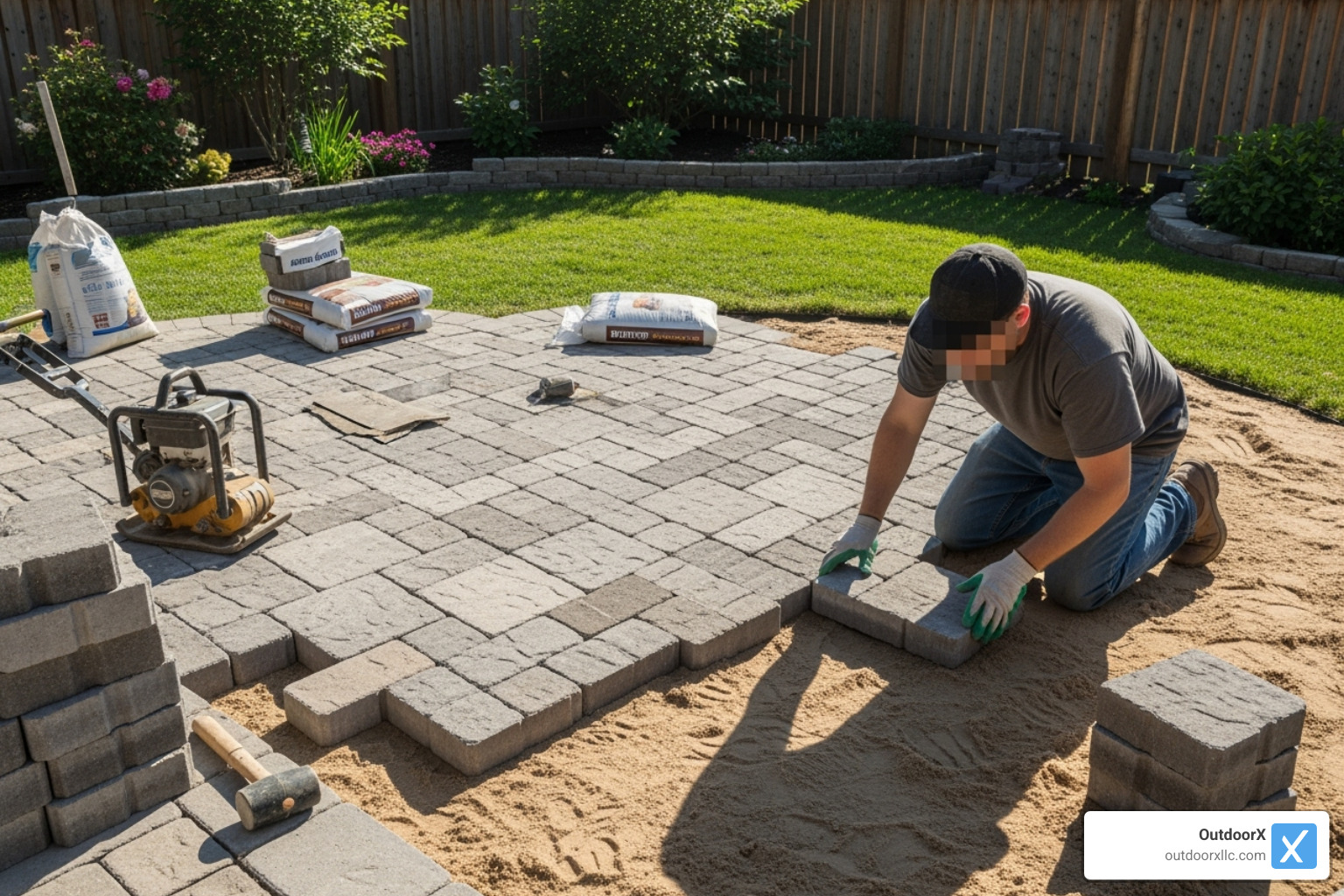
Congratulations on your new paver patio! Like any part of your home, it requires ongoing care to thrive. While a DIY patio paver installation is rewarding, it’s also important to know when to call a professional.
Long-Term Paver Patio Care
A well-maintained paver patio provides years of enjoyment. Here are our best practices for long-term paver patio care:
First, regular cleaning is key. Sweep debris often and hose down the patio. For tough spots, use a stiff brush and mild detergent. Be cautious with power washing, as it can dislodge jointing sand; be prepared to re-sand if you do.
For weed prevention, the polymeric sand does most of the work. Remove any occasional weeds by hand or with a targeted weed killer to keep your patio looking pristine.
Over time, jointing sand can settle or erode. Inspect your joints annually and re-sand them every 2-3 years as needed. This simple step maintains the patio’s structural integrity. Just sweep in new polymeric sand and activate it with water.
Finally, consider sealing pavers for protection. This optional but recommended step protects from stains, improves color, and defends against weather and UV damage. Wait at least 60 days post-installation before sealing to allow any efflorescence (a white residue) to be cleaned off first.
DIY vs. Hiring a Professional for your patio paver installation
A DIY patio paver installation can be rewarding, offering cost savings and a sense of pride. A standard patio can be a satisfying weekend project, especially with help.
However, be realistic about the project’s demands. Sometimes, hiring a professional is the best decision for your home and peace of mind.
Consider bringing in the experts if:
- The project is large or complex: Expansive patios, multi-level designs, or intricate patterns require a level of labor and precision that can be overwhelming for a DIYer.
- You have poor soil conditions: Heavy clay or sandy soil may need special preparation or drainage solutions that go beyond standard DIY knowledge.
- You lack the time or tools: Paver installation is physically demanding. If you’re short on time or prefer not to rent heavy equipment, a professional team has the tools and manpower.
- You want a flawless, guaranteed result: Professional contractors have the experience to ensure your patio is installed correctly, with proper drainage, stability, and aesthetic appeal, while meeting all local codes.
At OutdoorX, we specialize in custom landscaping and hardscaping services in South Hamilton, MA, and throughout Essex County. Our team brings expert craftsmanship and high-quality materials to every project. We can transform your outdoor space into a beautiful, functional area custom precisely to your preferences, from Andover to Wenham and all towns in between.
Frequently Asked Questions about Patio Paver Installation
How deep do I need to dig for a paver patio?
The excavation depth is key for a long-lasting patio paver installation. For most residential patios and walkways, dig down 6-8 inches, plus the paver thickness. This allows for a 4-6 inch compacted gravel base and a 1-inch sand bedding layer, ensuring stability.
For driveways or areas supporting heavy vehicles, you must excavate deeper—typically 10-12 inches plus the paver thickness—to create a stronger base.
Remember: always call 811 before you dig! This free service marks underground utilities, preventing dangerous and costly accidents.
Can I lay pavers directly on dirt or over an old concrete patio?
We strongly advise against laying pavers directly on dirt. Without a properly prepared and compacted base of gravel and sand, pavers will inevitably shift, sink, and become unstable, leading to poor drainage and a short-lived patio.
Laying pavers over an old concrete patio (a “direct overlay”) is sometimes possible, but only if the existing concrete is in excellent condition: structurally sound, free of major cracks, and with adequate drainage. You would still need a layer of bedding sand and special edge restraints. However, for the best results and maximum longevity, we often recommend removing the old concrete entirely and building a new base from scratch.
How do I prevent weeds from growing between my pavers?
Preventing weeds in your paver patio is achievable with the right materials during your patio paver installation.
Your first line of defense is geotextile fabric under the gravel base, which blocks weeds from growing up from the soil beneath.
The most effective tool for weed prevention is polymeric sand. This specialized sand fills the joints and hardens when activated with water, creating a strong barrier that locks pavers in place and makes it extremely difficult for weeds to take root.
Finally, sealing your pavers adds another layer of protection, making the surface less hospitable for weed seeds. Regular cleaning and promptly removing any stray weeds that appear will also keep your outdoor oasis looking its best.
Conclusion: Enjoy Your New Outdoor Oasis
From planning to the final sweep of sand, this guide has detailed the patio paver installation process. Each step, from careful planning to meticulous base preparation, builds a lasting foundation for countless outdoor memories.
A beautiful, durable paver patio is an extension of your home, perfect for any occasion. A well-installed patio increases your home’s value, provides a durable, long-lasting surface, and creates an inviting, custom-designed area for better outdoor living. It’s about building your dream.
While a DIY patio paver installation is rewarding, some projects call for expert hands. If your vision is complex, the labor seems overwhelming, your soil is challenging, or you simply want the peace of mind that comes with a guaranteed, flawless result, consider a professional.
That’s precisely where the expert team at OutdoorX shines! We’re here to take the heavy lifting off your shoulders and bring your outdoor dreams to life. We pride ourselves on creating beautiful, functional outdoor areas custom-built to your preferences with high-quality materials and expert craftsmanship. From our base in South Hamilton, MA, we’re proud to serve communities throughout Essex County, including Andover, Beverly, Boxford, Danvers, Essex, Georgetown, Gloucester, Ipswich, Lynnfield, Manchester-by-the-Sea, Marblehead, Newburyport, North Andover, North Reading, Peabody, Rockport, Rowley, Salem, Swampscott, Topsfield, and Wenham.
Ready to transform your backyard into the outdoor oasis you’ve always dreamed of? Don’t hesitate to explore our patio design and installation services to get started. Let’s create something beautiful together!
