Low Maintenance Landscaping: 5 Powerful Ways to Stunning Yards
Why Your Yard Should Work for You, Not Against You
Low maintenance landscaping is an approach to outdoor design that creates beautiful, functional spaces requiring minimal time, effort, and resources to maintain.
Quick Guide to Low Maintenance Landscaping:
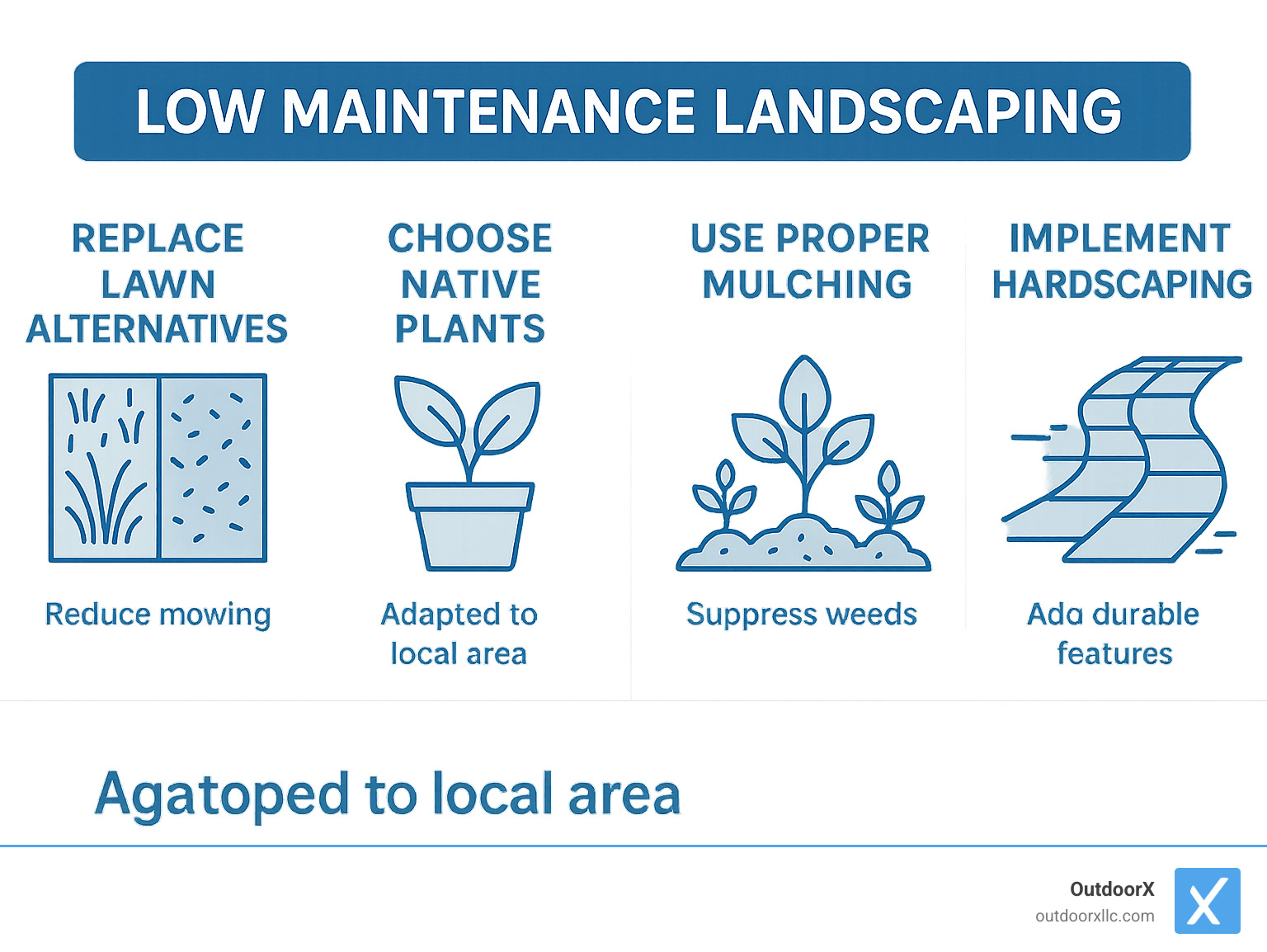
1. Replace lawn areas with hardscaping (patios, gravel) or native ground covers
2. Choose native plants adapted to your local climate and soil conditions
3. Group plants by water needs to simplify irrigation
4. Apply 3-4 inches of mulch to suppress weeds and retain moisture
5. Install efficient irrigation systems with smart controllers or timers
Every weekend spent mowing, weeding, and pruning is a weekend you could be relaxing and enjoying your outdoor space. According to research, homeowners can spend up to 70 hours per season on lawn care alone – that’s nearly three full days of your life each year!
“Traditional garden design often treats plants as objects to control, resulting in ecological nightmares; it’s time to cooperate with nature,” notes one landscaping expert. This sentiment captures the essence of low maintenance landscaping – working with natural systems rather than constantly fighting against them.
The appeal of having a beautiful yard is undeniable, but the upkeep shouldn’t become a second job. Whether you’re a busy professional, a retiree looking to simplify, or simply someone who’d rather spend weekends with family instead of fighting weeds, low maintenance landscaping offers a practical solution.
In Essex County, MA, where weather patterns swing from harsh winters to humid summers, designing a landscape that thrives with minimal intervention requires thoughtful planning and smart choices. The good news? With the right approach, you can create an outdoor space that’s both stunning and simple to maintain.
Why Low Maintenance Landscaping Matters: Definition, Benefits, Environmental Impact
Low maintenance landscaping is more than just a design trend – it’s a practical approach to creating outdoor spaces that align with how we actually live our lives. At its heart, this landscaping philosophy focuses on creating beautiful yards that don’t demand constant attention.
When we talk about low maintenance landscaping, we’re describing outdoor spaces that thrive with minimal human intervention. These landscapes are designed to require less water once established, need infrequent mowing and pruning, naturally resist local pests and diseases, and flourish in your specific climate without constant babysitting.
The water-saving benefits alone make this approach worth considering. Research shows that replacing traditional thirsty lawns with ground cover alternatives like Kurapia can slash water usage by up to 60%. This is particularly relevant for Essex County homeowners during our increasingly dry summer months.
“What happens when we give preference to plants that thrive in our bioregions?” asks a prominent landscape designer. “We create gardens that grow old gracefully with us and are more rewarding.”
Time savings might be the most immediate benefit you’ll notice. Instead of spending your weekends pushing a mower or pulling weeds, you’ll actually have time to enjoy your outdoor space. Native plants generally require significantly less water, fertilizer, and pesticides than non-native species, meaning fewer trips to the garden center and more time in your hammock.
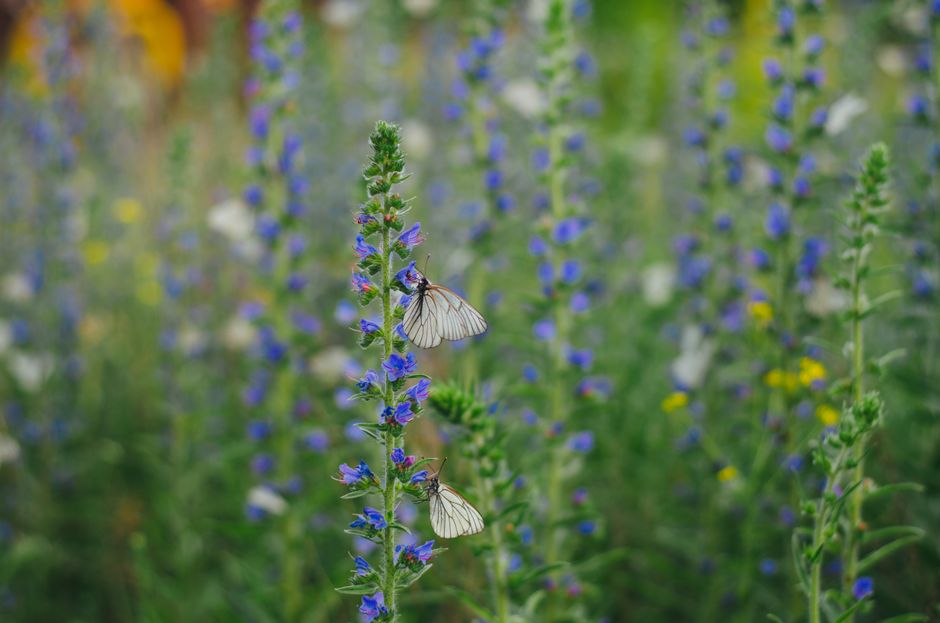
The environmental benefits extend far beyond your property line. Native plants have evolved over thousands of years to thrive in our local climate, making them naturally adapted to handle New England’s weather patterns. They also provide essential habitat for local wildlife, particularly our struggling pollinators. According to scientific research on native plants, these indigenous species are critical for supporting local ecosystems.
The Hidden Costs of High-Maintenance Yards
Traditional lawn-centric landscapes come with price tags that aren’t always obvious at first glance. The average American spends over 70 hours per year just on basic lawn care – that’s nearly three full days of your life annually! Between equipment, fertilizers, pesticides, and water, maintaining a traditional lawn typically costs between $500-1,500 each year.
The environmental costs are even steeper. Gas-powered lawn equipment produces significant air pollution – a conventional lawn mower running for just one hour creates as much pollution as driving a car 45 miles. Then there’s the water waste, with up to 50% of outdoor water use being lost to inefficient irrigation methods.
Perhaps most concerning is the chemical runoff. Those fertilizers and pesticides don’t just stay on your lawn – they wash into our local waterways, contributing to water pollution throughout Essex County.
As one Hamilton resident told us, “I used to spend every Saturday morning mowing and trimming. Now my low maintenance yard gives me that time back, and I’ve noticed more birds and butterflies than ever before.”
Environmental Upside of Going Easy-Care
The environmental benefits of embracing low maintenance landscaping are substantial and far-reaching:
Your carbon footprint shrinks when you reduce or eliminate gas-powered equipment use. Native and adapted plants typically need 30-50% less water than conventional landscapes, helping conserve one of our most precious resources. The improved soil health that comes from less disturbance and more organic matter creates healthier ecosystems from the ground up.
Better stormwater control is another significant advantage. Deep-rooted native plants and permeable surfaces reduce runoff and erosion, helping manage increasingly intense rain events. And when it comes to wildlife habitat, even small yards can make a big difference when planted with native species.
“Native plants provide nectar for pollinators and essential food for local wildlife,” notes the Audubon Society. In Essex County, where development has fragmented many natural habitats, your yard can become a crucial ecological stepping stone.
The EPA’s research on water-efficient landscapes confirms that thoughtfully designed yards not only save resources but also create more resilient outdoor spaces that can better withstand our changing climate conditions.
At OutdoorX, we’ve seen how low maintenance landscaping transforms not just yards, but lifestyles – giving homeowners beautiful outdoor spaces that improve their lives rather than demanding constant work. The environmental benefits are just the icing on the cake.
Planning Your Low Maintenance Landscaping: Site Analysis to Design
The foundation of any successful low maintenance landscape begins with proper planning. As we tell our clients in South Hamilton and throughout Essex County, an hour of planning saves days of future maintenance.
“Good design and garden planning up front will save time and money over the life of the landscape,” explains a garden design expert. This couldn’t be more true when aiming for low maintenance.

Step 1 – Analyze Your Site Like a Pro
Before purchasing a single plant or paver, take time to understand your property:
- Soil testing: Have your soil professionally tested through UMass Extension Service to identify pH levels and nutrient deficiencies. Essex County soils vary widely, from sandy coastal compositions to heavy clay inland.
- Sun mapping: Track sun patterns throughout the day and across seasons. Note which areas receive full sun (6+ hours), partial sun (4-6 hours), or shade (less than 4 hours).
- Identify problem areas: Look for spots with poor drainage, erosion issues, or where plants consistently struggle.
- Note existing features: Document mature trees, structures, utilities, and views you want to preserve or screen.
- Consider traffic patterns: Observe how people naturally move through your space to place paths and activity areas accordingly.
One Ipswich homeowner shared, “After mapping our yard’s sun patterns, we realized why our previous plants always struggled. Now our sun-loving natives thrive in the bright spots, while shade-tolerant varieties flourish under the maple tree.”
Low Maintenance Landscaping Zones
A key principle in low maintenance design is creating maintenance zones:
- Zone 1 (High Impact): Areas closest to the house or most visible from the street. These get the most attention and can feature some higher-maintenance elements for maximum visual impact.
- Zone 2 (Moderate Care): Transitional areas that receive regular but less intensive care. Perfect for mixed beds of perennials and shrubs.
- Zone 3 (Minimal Care): Peripheral areas that receive minimal intervention. Ideal for native plant communities, meadows, or naturalized areas.
“Maintenance zoning is a game-changer,” notes a landscape architect. “By concentrating your efforts where they matter most, you can dramatically reduce overall yard work.”
For maximum efficiency:
– Create large, sweeping planting beds with simple outlines rather than small, scattered beds
– Design wide paths (6-8 feet for main paths) that accommodate maintenance equipment
– Group plants with similar water and light requirements together
Functional Hardscape Footprints & Seating
Strategic hardscaping is the backbone of low maintenance landscaping. At OutdoorX, we recommend:
- Permeable patios and walkways that allow water to infiltrate while providing usable space
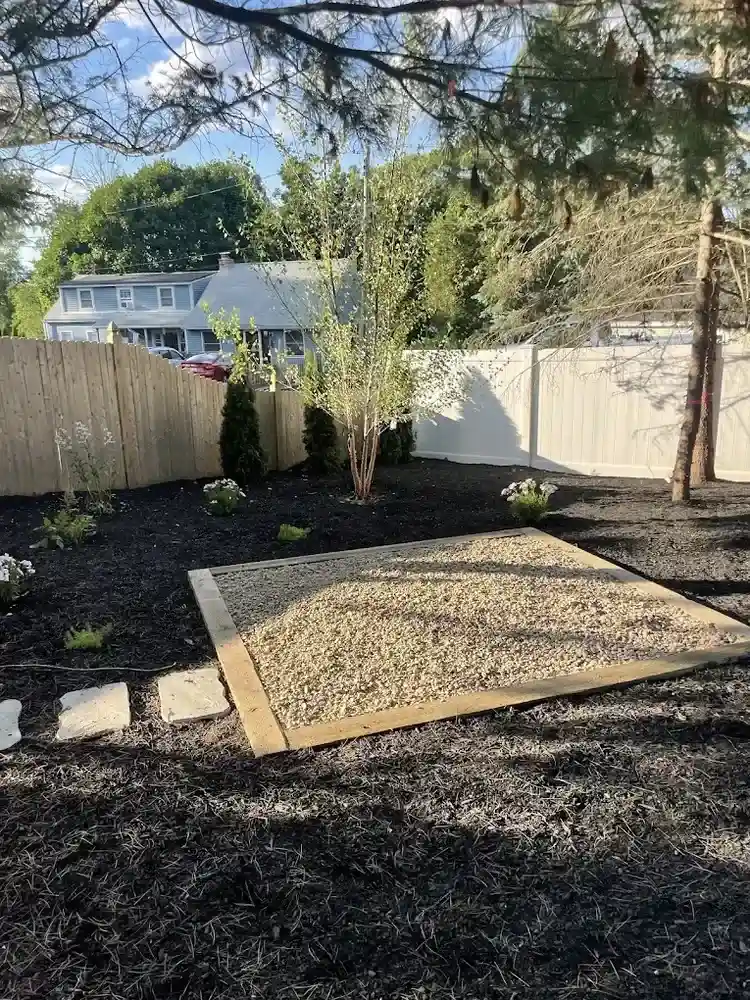
- Gravel or crushed stone areas for seating, fire pits, or transition zones
- Raised beds with stone or composite borders to contain plantings and reduce bending
- Built-in seating that eliminates the need to store and maintain furniture
“Replacing half my lawn with a paved patio and fire pit area was the best decision I made,” shares a Manchester-by-the-Sea client. “It’s where we spend most of our time now, and I’ve cut my mowing time in half.”
For maximum durability in New England’s freeze-thaw cycles, we ensure all hardscape elements are installed on properly compacted bases with appropriate drainage. This initial investment prevents costly repairs and ongoing maintenance.
Smart Plant & Lawn Selections for Every Region
The cornerstone of low maintenance landscaping is selecting the right plants for your specific conditions. As the saying goes: right plant, right place.
“Regionally native plants require the least water and care due to millennia of local adaptation,” explains a plant ecologist. This principle guides our plant selections at OutdoorX, especially for Essex County properties.

Low Maintenance Landscaping Plant Lists by USDA Zone
Essex County falls primarily within USDA Hardiness Zone 6a, which guides our plant selections. When we’re designing landscapes in Ipswich or Manchester-by-the-Sea, we often recommend native standouts like Eastern Redbud trees with their spectacular spring blooms and Serviceberry which offers four-season interest with spring flowers, summer berries, fall color, and attractive winter bark.
For shrub layers, Inkberry Holly provides evergreen structure without the fussiness of boxwood, while Arrowwood Viburnum delivers white spring flowers, blue fall berries, and exceptional drought tolerance once established. Ninebark varieties have become client favorites for their colorful foliage and resistance to deer browsing.
In the perennial beds, we’ve had tremendous success with Butterfly Weed and Black-Eyed Susan – both create vibrant color while standing tough through summer heat. Native grasses like Switchgrass and Little Bluestem add movement, winter interest, and require just one annual cutback in late winter.
“I’ve found that native plants not only require less care, but they bring life to my yard,” shares a Rockport homeowner. “The birds, butterflies, and even beneficial insects have increased dramatically since I switched from exotic ornamentals to natives.”
Lawn Alternatives That Save Hours
Traditional lawns can feel like a part-time job. That’s why we’re seeing more Essex County homeowners accept alternatives that slash maintenance time while enhancing ecological value.
No-Mow Fescue Blends have transformed many of our clients’ weekends. These specialized grass mixes develop deeper root systems than conventional turf and only need mowing 1-3 times per year. They stay green with minimal irrigation, even during those dry July stretches.
Clover lawns have made a remarkable comeback in recent years. As one Wenham client told us, “I haven’t bought fertilizer in three years since switching to clover.” That’s because clover fixes its own nitrogen from the air. It also stays green during drought conditions when traditional lawns go dormant, and the tiny flowers support local pollinators.
For areas with light foot traffic, ground covers like Kurapia can reduce water usage by up to 60% compared to traditional lawns. Creeping Thyme offers a fragrant alternative that releases its scent when walked upon, while native Pennsylvania Sedge thrives in those tricky partially shaded areas where grass struggles.
“We replaced our front lawn with a meadow of native grasses and wildflowers,” explains a Beverly client. “It only needs cutting once a year in late winter, and it’s become a neighborhood conversation piece.”
Trees & Shrubs That Behave Themselves
Not all woody plants deserve a place in your low maintenance landscape. Some drop messy fruits, require constant pruning, or become magnets for pests and diseases.
For well-behaved trees, we often recommend Serviceberry for its multi-season interest and minimal leaf drop. Redbud trees offer spectacular spring flowers with a naturally attractive form that rarely needs corrective pruning. The native American Hornbeam makes an excellent understory tree with beautiful fluted bark and remarkably few pest issues.
In the shrub category, Dwarf Inkberry Holly provides evergreen structure with a naturally compact growth habit that won’t swallow your walkways. Virginia Sweetspire delivers fragrant spring flowers and exceptional fall color without the constant maintenance of many exotic alternatives. For clients who love roses but hate the fussiness, Knock Out varieties have been – they’re self-cleaning, meaning you can skip the tedious deadheading.
“I spent years fighting with my boxwoods that kept dying back on one side,” shares a Georgetown resident. “Switching to native inkberry holly gave me the same evergreen structure without the constant problems.”
The science supports these choices too. According to research from the Audubon Society, native plants require less maintenance while providing essential habitat for local wildlife. Their deep root systems improve soil health and manage stormwater more effectively than many non-native alternatives.
When you’re ready to transform your high-maintenance yard into a beautiful, easy-care landscape, choosing the right plants for our Essex County climate isn’t just convenient—it’s the smart approach to creating a sustainable outdoor space that works with nature, not against it.
Hardscaping & Material Hacks that Slash Upkeep
There’s something magical about hardscaping when it comes to creating a truly low maintenance landscape. Think of hardscape elements as the reliable backbone of your outdoor space – they provide structure and beauty without demanding weekly attention or seasonal replanting.
“I tell my clients that every square foot of hardscaping is a square foot you’ll never have to mow, water, or weed again,” says John, one of our landscape designers at OutdoorX. We’ve helped countless Essex County homeowners transform their high-maintenance yards into beautiful, functional spaces that don’t demand constant attention.

Pros & Cons of Mulch, Rock & Synthetic Turf
When it comes to ground coverings, each option has its sweet spots and drawbacks. Let’s break them down:
| Material | Pros | Cons | Lifespan | Maintenance Required |
|---|---|---|---|---|
| Organic Mulch | Improves soil, suppresses weeds, retains moisture | Needs replenishment every 1-2 years | 1-2 years | Annual top-dressing |
| Stone/Gravel | Permanent, excellent drainage, no replacement needed | Can get hot, some weed growth between stones | 10+ years | Occasional raking, potential weed control |
| Artificial Turf | No mowing, watering, or fertilizing | High upfront cost ($7-$21/sq ft*), can get hot | 8-15 years | Occasional rinsing, brushing |
*Average costs based on internet data, not actual OutdoorX pricing.
We’ve found that organic mulch works wonders in planting beds. It breaks down slowly, feeding your soil while keeping weeds at bay. One of our Ipswich clients puts it perfectly: “The cedar mulch not only looks beautiful against my hydrangeas, but I’ve noticed my plants need less watering since I started using a thick layer.”
Stone and gravel shine in pathways and transition areas. They’re practically permanent, and that initial investment pays off year after year. “The bluestone path OutdoorX installed five years ago looks just as good today as when it went in,” shares a satisfied client from Wenham. “No weeds, no maintenance – just sweep the leaves off occasionally.”
As for artificial turf, it’s come a long way from the plastic-looking stuff of the past. While the upfront cost is significant (anywhere from $7 to $21 per square foot based on internet data), the zero-maintenance aspect is appealing for small, hard-to-grow areas. One Newburyport homeowner told us, “We installed artificial turf in that shady corner where nothing would grow, and it’s been maintenance-free for five years.”
In Essex County’s climate, we typically recommend a thoughtful mix of all three materials, strategically placed where each can perform at its best.
Retaining Walls, Borders & Raised Beds
Nothing ruins the clean lines of a beautiful landscape faster than lawn grass invading your flower beds or mulch washing onto your walkways after a heavy rain. That’s where proper edging and borders come in – they’re the unsung heroes of low maintenance landscaping.
Well-defined borders create clear separations between different landscape elements, dramatically reducing edge maintenance. A sturdy border prevents lawn grass from creeping into beds, contains mulch during heavy rains, and creates clean lines that make string-trimming quicker and more precise.
At OutdoorX, we love working with these materials for borders and edges:
Steel edging offers a modern, almost invisible line that’s perfect for contemporary landscapes. It’s particularly effective for curved beds, creating a clean division between lawn and garden without drawing attention away from your plants.
Natural stone borders blend perfectly with New England’s aesthetic and literally get better with age. While more expensive initially, they never need replacement and add significant property value.
Composite materials work wonderfully for raised beds and planters, offering the look of wood without the rot or termite concerns. They’re particularly useful for vegetable gardens and herb beds where frequent access is needed.
A client in Essex shares, “The raised stone beds OutdoorX installed completely transformed my garden experience. I’m in my 70s, and not having to bend down as far has kept gardening enjoyable. Plus, they look absolutely beautiful with our historic home.”
For retaining walls that last generations, proper installation is everything. Our team at OutdoorX ensures proper drainage behind every wall we build, preventing the freeze-thaw damage so common in New England. Learn more about our Garden Retaining Wall Design services that combine beauty with long-lasting performance.
Whether you’re looking to reduce maintenance with strategic hardscaping or create a complete outdoor living space, our Hardscaping team can transform your Essex County property into a beautiful, low-maintenance landscape that gives you more time to enjoy the outdoors, rather than working in it.
Water, Soil & Weed Management for Set-and-Forget Gardens
The secret to truly low maintenance landscaping lies in setting up smart systems that do the work for you. Getting your water, soil, and weed management right from the start means less time maintaining and more time enjoying your outdoor space.
“I tell all my clients that good soil is like the foundation of a house—skip it, and everything else becomes a constant struggle,” shares our lead designer at OutdoorX. This philosophy guides every landscape we create in Essex County.

Low Maintenance Landscaping Irrigation Solutions
Water-wise irrigation isn’t just environmentally responsible—it’s the cornerstone of a hands-off landscape. In Essex County, where summer dry spells can stress plants, having the right system makes all the difference.
Drip irrigation has revolutionized how we water gardens. These systems deliver moisture directly to plant roots, cutting water waste by up to 50% compared to sprinklers. One Ipswich client told us, “Since installing drip lines, my water bill dropped dramatically, and my plants have never looked healthier.”
Smart controllers take efficiency even further by automatically adjusting watering schedules based on weather conditions. When it rains, these systems know to skip watering—no more embarrassing sprinklers running during downpours!
For budget-friendly options, soaker hoses work wonderfully in smaller beds. And for the ultimate in sustainability, we often incorporate rain barrels to capture roof runoff that would otherwise go to waste.
Traditional clay olla jars offer an ancient solution that’s making a comeback. These unglazed pots are buried near plants and filled with water, which slowly seeps through the clay directly to roots. They’re perfect for isolated plants or containers where running irrigation lines might be impractical.
During Essex County’s occasional water restrictions, having efficient irrigation means your landscape stays vibrant while following conservation guidelines. As research from UMass confirms, proper watering not only saves resources but creates stronger, more resilient plants.
Weed & Mulch Tactics that Actually Work
Nothing eats up garden time like weeding. But with smart prevention strategies, you can dramatically reduce this chore.
The humble mulch layer might be your strongest ally in the battle against weeds. A 3-4 inch layer of organic mulch blocks light from reaching weed seeds while conserving soil moisture. “Just be sure to keep mulch pulled back about a foot from tree trunks,” advises our maintenance team lead. “That prevents potential bark rot and discourages rodents.”
Many homeowners underestimate the power of dense planting. When plants grow shoulder-to-shoulder, they shade the soil and leave little room for weeds to establish. A North Andover client remarked, “My beds used to be weed magnets until OutdoorX redesigned them with proper spacing. Now the plants have filled in, and I barely pull any weeds.”
Regular quick “weed patrols” prevent small problems from becoming overwhelming. Spending just 10 minutes walking your garden once a week with a trowel in hand can save hours of backbreaking work later.
For pathways and hardscaped areas, quality landscape fabric under a layer of gravel or stone provides lasting weed suppression. “The key is using professional-grade material,” explains our hardscape specialist. “The thin stuff from big box stores deteriorates quickly and ends up being more trouble than help.”
Soil Prep for Long-Term Success
Think of soil as the foundation of your low maintenance landscape. Skip this step, and you’ll pay for it with years of extra work.
In Essex County, we encounter everything from sandy coastal soils to heavy inland clay. Each presents unique challenges, but the solution often starts with the same ingredient: organic matter. Adding compost improves both drainage in clay soils and water retention in sandy soils—a win-win for plant health.
“We always recommend loosening soil about 12 inches deep before planting,” notes our soil specialist. “That initial investment of effort pays off for years as plants develop deep, drought-resistant root systems.”
For particularly challenging sites, we sometimes incorporate specialized amendments like biochar to improve soil biology or perlite to improve drainage. These materials create long-lasting improvements that won’t break down quickly like compost.
Raised beds offer another solution for poor native soil. By building up rather than digging down, you can create the perfect growing environment regardless of what lies beneath. A Boxford client shared, “The raised stone beds OutdoorX built transformed our heavy clay yard into a thriving garden that practically takes care of itself.”
Soil testing through UMass Extension Service gives us precise information about pH and nutrient levels, allowing targeted amendments rather than guesswork. This scientific approach ensures plants get exactly what they need—no more, no less—resulting in stronger plants that resist pests and disease naturally.
With these fundamentals in place—efficient irrigation, effective weed prevention, and healthy soil—your landscape shifts from demanding constant attention to practically taking care of itself. That’s the true essence of low maintenance landscaping: smart systems working together so you don’t have to.
Budget-Friendly Ideas, Mistakes to Avoid & Year-Round Curb Appeal
Creating a low maintenance landscape doesn’t have to break the bank. With strategic planning and phased implementation, you can transform your yard over time.
“Some people love the backbreaking business of taking care of their lawn and garden. Then there’s the rest of us: We’d rather relax and let our little piece of heaven largely take care of itself,” notes a landscaping writer. We couldn’t agree more.
Top Budget Hacks That Don’t Look Cheap
Transform your landscape gradually with these cost-effective approaches:
Budget-Friendly Strategies:
– Start with a master plan but implement in phases as budget allows
– Divide existing perennials every few years to fill new beds for free
– Participate in local plant swaps to diversify your garden inexpensively
– Use municipal compost often available free or at low cost to residents
– Choose young plants which establish quickly and often outperform larger specimens
– Incorporate found objects as garden art or functional elements
“I began with just the front foundation planting and added a new section each year,” explains a Salem homeowner. “Five years later, my entire yard is low maintenance, and I never had to spend a large sum at once.”
For hardscaping, costs can vary widely based on materials and installation methods. Internet data suggests average costs range from $8-$30 per square foot for patios and walkways. By starting with gravel paths and upgrading to stone over time, you can spread these costs while still enjoying a functional space.
Mistakes to Dodge on Your First Try
Even experienced gardeners make these common low maintenance landscaping mistakes:
Common Pitfalls:
– Choosing plants unsuited to your conditions: Always check hardiness zones and sun/water requirements
– Creating tiny, scattered beds: These increase edge maintenance; opt for fewer, larger beds
– Using rock in landscape beds: It tends to wash out and complicate maintenance
– Skipping soil preparation: Poor soil leads to struggling plants that need more care
– Overcrowding plants: While dense planting helps, proper spacing prevents disease issues
– Forgetting about maintenance access: Ensure you can reach all areas for occasional care
“I made the mistake of using rock mulch in my beds, and it was a nightmare,” shares a Peabody resident. “Leaves and debris would get trapped in it, and it was impossible to clean properly. I’ve since switched to hardwood mulch, which breaks down to feed the soil.”
At OutdoorX, we help clients avoid these mistakes through proper planning and material selection based on our experience with Essex County’s specific conditions.
Keeping Curb Appeal High with Low Effort
A truly successful low maintenance landscape looks great year-round with minimal intervention:
Four-Season Interest Strategies:
– Plant for sequential blooming: Ensure something is flowering or fruiting each season
– Include structural evergreens: These provide year-round backbone to the landscape
– Incorporate ornamental grasses: They offer winter interest and need cutting just once annually
– Select trees and shrubs with multiple seasons of interest: Spring flowers, summer form, fall color, winter bark
– Add landscape lighting: Automated systems create nighttime appeal with zero ongoing effort
“Designing for all four seasons ensures year-round curb appeal with minimal intervention,” explains a landscape designer.
In Essex County, where winter can last for months, we emphasize:
– Evergreen foundation plantings
– Trees with interesting bark or form (river birch, paperbark maple)
– Ornamental grasses that stand through winter
– Native shrubs with persistent berries for winter interest and wildlife value
A Gloucester client tells us, “I’m amazed how my yard looks intentional and beautiful every season now. The winter garden has become my favorite, with the grasses swaying in the snow and birds visiting the berry-laden shrubs.”
Conclusion
Creating a beautiful yard without endless maintenance isn’t just possible—it’s increasingly becoming the preferred approach for busy homeowners who want to enjoy their outdoor spaces rather than constantly work on them.
The principles of low maintenance landscaping we’ve explored—from thoughtful planning and native plant selection to strategic hardscaping and efficient irrigation—work together to create landscapes that largely take care of themselves.
As we’ve seen throughout Essex County, from coastal properties in Marblehead and Gloucester to inland gardens in Andover and North Reading, these principles can be adapted to any site and style preference. The key is working with natural systems rather than against them.
At OutdoorX, we specialize in creating custom low-maintenance landscapes that reflect each client’s unique needs and aesthetic preferences. Our team understands the specific challenges of New England’s climate and soils, and we bring that expertise to every project, whether it’s a complete landscape change or targeted improvements to reduce maintenance in problem areas.
Even the most low-maintenance landscape will require some care, but the difference is remarkable—think occasional seasonal tasks rather than weekly chores. As one Ipswich client put it, “I’ve gone from spending every weekend maintaining my yard to enjoying it instead. That’s the real value of low maintenance landscaping.”
Ready to transform your outdoor space into a beautiful, low-maintenance retreat? Contact OutdoorX for a consultation. We serve South Hamilton and communities throughout Essex County with expert design, installation, and maintenance services custom to your lifestyle and preferences.