


Building a patio with pavers: Perfect DIY Guide 2025
Why Building a Patio with Pavers Transforms Your Outdoor Space
Building a patio with pavers is one of the most rewarding DIY projects you can tackle, creating a durable outdoor space that can last 30 years or more. This intermediate-level project takes about 8 hours total working time and can dramatically increase your home’s value while providing years of outdoor enjoyment.
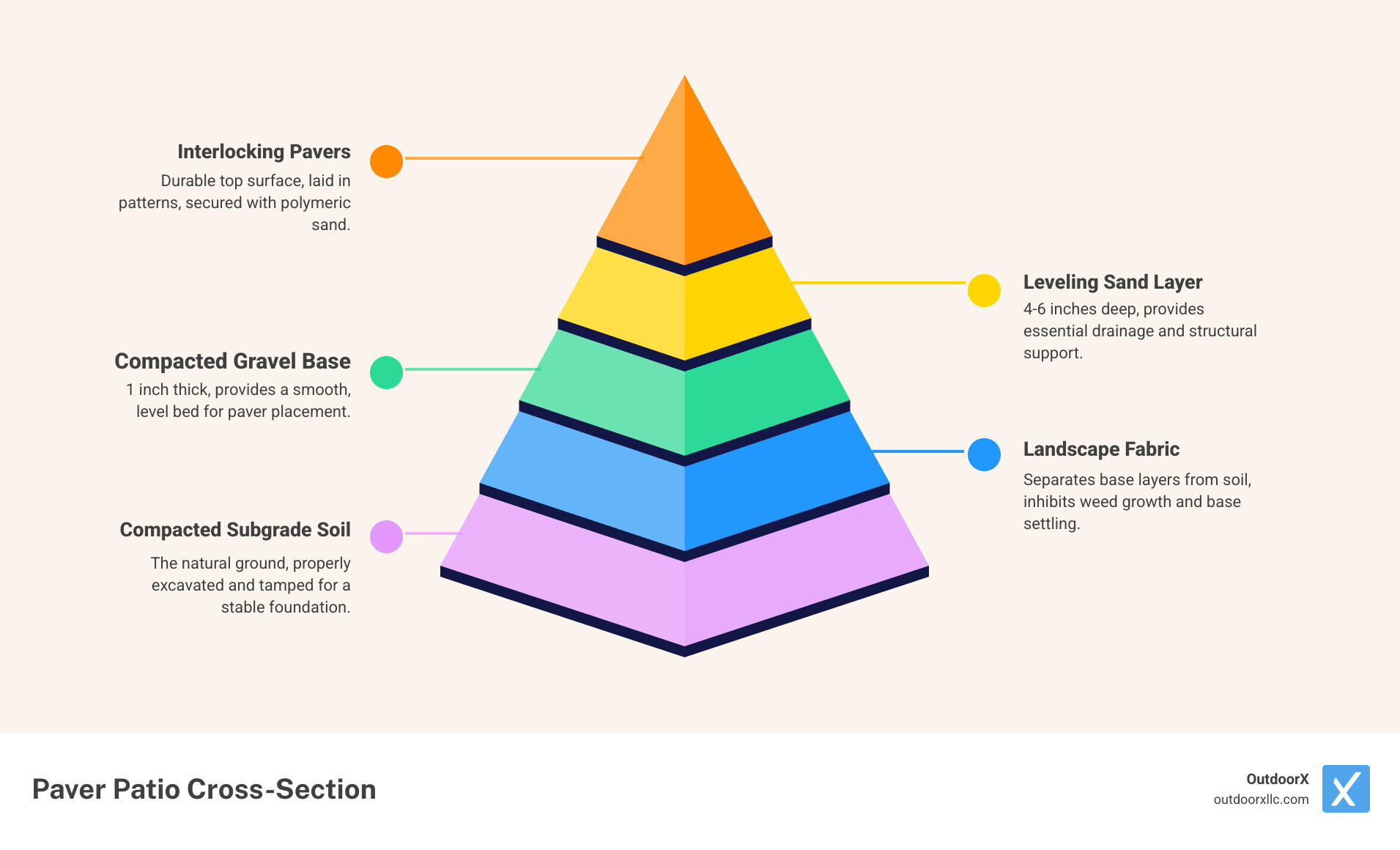
Quick Guide to Building a Paver Patio:
- Plan and measure your patio area (typically 16×18 feet for average use)
- Excavate 6-8 inches deep, accounting for base materials and pavers
- Install landscape fabric to prevent weeds
- Add gravel base – 4-6 inches compacted
- Level sand layer – 1 inch thick
- Lay pavers starting from corner, maintaining 1/8-inch gaps
- Install edging and sweep polymeric sand into joints
- Compact and cure for 24 hours before use
Unlike poured concrete, pavers offer incredible flexibility. If one cracks, you replace just that piece. They handle freeze-thaw cycles better and create beautiful patterns that complement any home style.
The key to success lies in proper preparation. As one expert puts it: “Preparation is critical to success for a DIY patio paver project.” A well-compacted base prevents the settling and shifting that ruins cheaper installations.
Cost considerations vary widely based on materials and size. Basic concrete pavers start around $2-5 per square foot for materials, while premium natural stone can reach $15-50 per square foot. A typical 288 square foot patio requires about 1,300 pavers, 96 cubic feet of gravel, and 48 cubic feet of sand.
The satisfaction of creating your own outdoor paradise, combined with the durability and beauty of pavers, makes this project worth the weekend investment.
Glossary for building a patio with pavers:
Phase 1: Planning Your Perfect Patio
The secret to building a patio with pavers that stands the test of time? It’s all in the planning. Before we grab our shovels or order a single paver, we need to create a roadmap that ensures our dream patio becomes reality.

Site selection is our first big decision. We want to find that sweet spot where our patio gets the right amount of sun throughout the day – not too scorching in the afternoon, but bright enough to enjoy our morning coffee. Privacy matters too. Nobody wants to feel like they’re dining in a fishbowl while neighbors peer over the fence.
Proximity to the house is crucial for both convenience and functionality. The closer we build to our back door, the easier it becomes to carry food and drinks outside. Plus, we’ll want to think about how the patio looks from inside our home – after all, we’ll be admiring it through our windows year-round.
Budgeting keeps our dreams grounded in reality. Material costs vary widely, from basic concrete pavers at around $2-5 per square foot to premium natural stone that can reach $15-50 per square foot for materials alone. For a typical 288 square foot patio, we’re looking at anywhere from $600 to $14,400 just for pavers – quite a range!
When it comes to design and patterns, this is where we get to have some fun. The classic running bond pattern (like a brick wall) is foolproof for beginners, while herringbone creates stunning visual interest but requires more precise cutting. The pattern we choose affects both the final look and the complexity of installation – something to keep in mind if this is our first hardscaping project.
Essential Tools and Materials
Success in building a patio with pavers starts with having the right gear. Think of this as assembling our superhero toolkit – each item plays a specific role in creating our perfect outdoor space.
Our excavation heroes include a sturdy shovel and spade for digging, plus a rake to spread materials evenly. The real muscle of our operation? A tamper – either hand-operated for smaller projects or power-driven for larger areas. Trust us, our backs will thank us for renting a power tamper if we’re tackling more than 200 square feet.
Precision tools make all the difference between a professional-looking result and a wobbly mess. We’ll need a level and straight board (an 8-foot 2×4 works perfectly) for checking slopes and screeding sand. Mason’s line and stakes help us mark our perimeter and maintain proper drainage slopes. A rubber mallet gently coaxes stubborn pavers into place without cracking them.
Safety gear isn’t optional – safety glasses and gloves protect us from flying debris and rough materials. If we’re cutting pavers, a dust mask becomes essential too.
For materials, our foundation starts with landscape fabric to block weeds, followed by gravel base (typically 3/4-inch crushed stone) and leveling sand (fine builder’s sand). The pavers themselves are our stars, available in countless colors, sizes, and textures. Edge restraints (plastic or metal) lock everything in place, while polymeric sand fills joints and hardens when wet, creating a solid, weed-resistant surface.
Electrical conduit makes an excellent screed rail for leveling sand, and a compact brick cutter or masonry saw handles any cutting needs for edges or complex patterns.
How to Calculate Materials Needed
Nothing kills project momentum like running out of materials halfway through. Let’s master the math that keeps our building a patio with pavers project running smoothly.
Start by sketching your design and measuring the actual space. A popular patio size is 16 by 18 feet, giving us 288 square feet of outdoor living space – perfect for a dining set plus room to move around comfortably.
Paver calculations depend on size. Standard 4×8-inch brick pavers require about 4.5 pieces per square foot. For our 288 square foot patio, that’s roughly 1,296 pavers. Always add a 5-10% waste factor – trust us, a few extra pavers in storage beats scrambling to match discontinued colors later.
Base material depth is critical. We need 4-6 inches of compacted gravel (use 6 inches for areas with heavy furniture or poor drainage). For our example patio with a 4-inch base, that’s 96 cubic feet of gravel (288 sq ft × 1/3 foot depth).
The sand layer should be exactly 1 inch thick when screeded. We’ll need about 24 cubic feet of leveling sand for our 288 square foot project.
Edge restraints require measuring the entire perimeter. Our 16×18 foot patio has 68 feet of perimeter (16+18+16+18), so we’ll order that length plus a few extra feet for waste.
Polymeric sand coverage varies by paver size and joint width – check the bag label, but typically one 50-pound bag covers 75-100 square feet.
The 2D Project Layout Planner Free tool helps visualize our design and double-check our calculations before ordering materials.
Key Safety Precautions and Regulations
Safety isn’t just about avoiding injury – it’s about protecting our investment and staying on the right side of local laws.
Call 811 before you dig – this isn’t a suggestion, it’s a must. Underground utilities like gas lines, electrical cables, and water pipes hide beneath innocent-looking grass. One wrong shovel thrust can turn our weekend project into a neighborhood emergency. The service is free and typically marks utilities within 2-3 business days.
Local building codes and HOA regulations vary dramatically by location. Some areas require permits for patios over certain sizes, while others have setback requirements from property lines. Homeowners associations often have their own rules about materials, colors, and designs. A quick call to our local building department and HOA saves headaches later.
Personal protective equipment protects our most valuable tools – ourselves. Safety glasses are non-negotiable when cutting pavers or working with flying debris. Gloves protect hands from rough materials and sharp edges. When cutting pavers, a dust mask prevents inhaling harmful silica particles.
Heavy lifting strategy matters too. Pavers are deceptively heavy – a single pallet can weigh 3,000 pounds or more. We strongly recommend having materials delivered as close to our work site as possible and enlisting helpers for the installation day.
Pavers vs. Other Materials
When planning our outdoor space, building a patio with pavers offers distinct advantages over other materials, though each option has its place.
| Feature | Pavers | Poured Concrete |
|---|---|---|
| Cost | Higher upfront material cost ($10-30/sq ft average installation), but excellent long-term value | Lower initial cost ($6-18/sq ft average), but repair costs can be significant |
| Durability | Exceptional – individual pavers can be replaced if damaged, handles freeze-thaw cycles excellently | Good initially, but prone to cracking over time, especially in cold climates |
| Repairability | Outstanding – replace individual pavers as needed without disturbing the rest | Poor – cracks often require extensive repair or complete replacement |
| Aesthetics | Unlimited patterns, colors, and textures available, ages beautifully | Limited to stamped or colored options, can look dated over time |
| DIY-friendliness | Moderate difficulty but very forgiving – mistakes can be corrected easily | High skill required for professional results, unforgiving once poured |
The beauty of pavers lies in their flexibility and repairability. If tree roots cause settling in one corner, we replace just those affected pavers. If we decide to add a fire pit later, we simply remove pavers from that area and reinstall them elsewhere.
Concrete patios work well for simple, large areas where budget is the primary concern. However, the old saying “you get what you pay for” often applies. When factoring in the potential for future repairs and the limited design options, pavers frequently offer better long-term value.
For those considering replacing old patio with pavers, the change can be dramatic – turning a plain concrete slab into a stunning focal point that improves our entire outdoor living experience.
The planning phase sets the foundation for everything that follows. Take time to get these decisions right, and our building a patio with pavers project will reward us with decades of outdoor enjoyment.
Phase 1: Planning Your Perfect Patio
The journey to your dream outdoor space begins with meticulous planning. This initial phase is crucial for laying the groundwork, not just physically, but also in vision and strategy. We want to ensure your new paver patio perfectly complements your home and lifestyle.
When selecting the ideal site for your patio, consider practical elements like sun exposure throughout the day. Do you want morning sun for breakfast, or evening shade for entertaining? Think about privacy from neighbors and the convenience of its proximity to the house for easy access to the kitchen or living room. Also, importantly, consider sight lines from your windows and doors; you want the patio to improve your view, not obstruct it.
Budgeting is another crucial step. We’ll need to account for the cost of the pavers themselves (which can range from simple concrete options to more intricate natural stone), the gravel base, leveling sand, edge restraints, and polymeric sand. Don’t forget potential tool rental fees for specialized equipment like a plate compactor or a masonry saw, which can significantly ease the workload for a one-time DIY project.
For design, explore various paver patterns such as running bond, herringbone, or pinwheel. Each offers a distinct aesthetic and can impact the complexity of the installation, particularly the amount of cutting required. Most importantly, ensure your patio is large enough to comfortably accommodate all your outdoor furniture, like a dining set or lounge chairs, with ample space to walk around. This thoughtful planning ensures your patio is both functional and beautiful.
Essential Tools and Materials
To start on our journey of building a patio with pavers, having the right tools and materials is paramount. This isn’t a project where improvising with inadequate equipment will lead to lasting success. Gathering everything beforehand ensures a smooth and efficient workflow.
Here’s a comprehensive list of what we’ll need:
- Shovel and Spade: For the initial excavation, removing soil, and moving aggregate materials.
- Rake (Iron Rake): Ideal for spreading and leveling the gravel and sand layers.
- Tamper (Hand or Power): Absolutely essential for compacting the subgrade soil and all subsequent base layers. For larger patios, a rented plate compactor will save us immense effort and ensure optimal compaction.
- Level and Straight Board (e.g., 2×4, 8 feet long): Crucial for checking slopes, ensuring flatness, and screeding the sand layer.
- Wheelbarrow: Indispensable for transporting heavy materials like gravel, sand, and the pavers themselves. Pavers can be quite heavy, so having materials delivered and enlisting a helper is highly recommended.
- Mason’s Line and Stakes: For accurately marking the patio perimeter and establishing the proper slope for drainage.
- Rubber Mallet: To gently tap and seat individual pavers into the sand bed without damaging them.
- Safety Glasses and Gloves: Non-negotiable personal protective equipment (PPE) to protect our eyes and hands from debris, dust, and potential abrasions.
- Pavers: The star of our show! They come in many types and sizes (e.g., 6×6-inch, 6×9-inch, 12×12-inch). For areas that will support heavy objects like hot tubs or large grills, we recommend using thicker paving stones.
- Gravel Base (Crushed Stone/Paver Base): This forms the structural foundation. A 3/4-inch crushed stone is commonly used.
- Leveling Sand (Builder’s Sand): A fine, coarse sand that provides the final bedding layer for the pavers.
- Edge Restraints: These are critical for preventing the pavers from shifting or spreading outwards. Options include plastic edging secured with spikes or even concrete or mortar for a more permanent border.
- Polymeric Sand (or Jointing Sand): This specialized sand, when activated with water, hardens to lock the pavers in place, preventing movement and inhibiting weed growth between the joints.
- Electrical Conduit (1-inch diameter, optional): These can be used as temporary guides or ‘tracks’ for screeding the sand layer evenly.
- Compact Brick Cutter or Masonry Saw: For cutting pavers to fit along edges or to create specific patterns. A dry saw or wet saw can be rented for this purpose. If we’re only making a few cuts, a compact brick cutter might suffice.
How to Calculate Materials Needed
Accurately calculating the quantities of materials needed for our paver patio is a crucial step that prevents costly re-orders and delays. Let’s get our sketchbooks out and crunch some numbers!
First, we’ll draw a detailed sketch of our envisioned patio. This helps us visualize the space and identify any irregular shapes. Then, we’ll measure the actual dimensions of our patio area to determine its total square footage. For instance, a common patio size is 16 by 18 feet, which gives us 288 square feet.
- Pavers: The number of pavers needed depends on their size. For average 4×8-inch brick pavers (which cover 32 square inches each), we’ll need approximately 4.5 pavers per square foot. So, for a 288 square foot patio, we would need roughly 1,296 pavers (288 sq ft * 4.5 pavers/sq ft). It’s always a best practice to buy an extra 5-10% to account for cuts, breakage, or future repairs.
- Landscape Fabric: Calculate the total surface area of your patio. When laying the fabric, we’ll need to ensure overlaps of 6-8 inches between pieces. So, factor in about 8 extra inches for each overlap.
- Gravel Base: Our research recommends a 6-inch layer of gravel, which typically compacts down to about 4 inches. To calculate the cubic feet of gravel needed, we multiply the patio’s square footage by 1/3 (for a 4-inch compacted depth). For our 288 square foot example patio, we’d need approximately 96 cubic feet of gravel (288 sq ft * 1/3). We’ll be adding this in 2-inch layers and compacting each one.
- Sand Layer: The leveling sand layer is typically 1 inch thick. As a general rule of thumb, we’ll need about 1/3 as much sand as gravel (measured in cubic volume). This means for 96 cubic feet of gravel, we’d need around 32 cubic feet of sand.
- Edging Material: Measure the entire perimeter of your patio. For a 16×18 foot patio, the perimeter is 68 feet. Purchase edging based on this measurement, adding a little extra for corners or mistakes.
- Polymeric Sand: The amount needed varies based on paver size and joint width. Always check the product’s coverage instructions on the bag.
To assist with these calculations, online tools like a 2D Project Layout Planner Free can be invaluable for estimating the materials we need.
Key Safety Precautions and Regulations
Safety is our utmost priority when starting on any home improvement project, and building a patio with pavers is no exception. Taking the right precautions not only protects us but also ensures our project complies with local requirements.
- Call 811 Before You Dig: This is perhaps the most critical step before any excavation. We must call 811 a few days before we plan to dig. This free service ensures that all underground utilities—gas lines, water pipes, electrical conduits, and communication cables—are marked. Digging into these can lead to serious injury, costly repairs, or widespread service outages. It’s truly a matter of life or death, so let’s not skip this one!
- Check Local Building Codes and HOA Regulations: Before we start, we need to contact our local building department and our Homeowners Association (if applicable) to inquire about any restrictions or permit requirements for patio construction. Some areas have specific rules regarding size, materials, drainage, or proximity to property lines. Getting the necessary permits beforehand avoids potential fines or, even worse, being forced to dismantle our hard work.
- Personal Protective Equipment (PPE): We always recommend wearing appropriate PPE throughout the project. This includes:
- Safety Glasses: To protect our eyes from flying debris, especially during excavation, compaction, and paver cutting.
- Work Gloves: To prevent blisters, cuts, and abrasions from handling rough materials like gravel and pavers.
- Dust Mask: Essential when cutting pavers or sweeping polymeric sand, as these processes can generate fine dust particles that are harmful to inhale.
- Sturdy Footwear: To protect our feet from heavy materials and potential punctures.
- Enlist a Helper for Heavy Lifting: As we’ve mentioned, pavers are heavy! We strongly advise enlisting a friend or family member to help with material delivery and placement. This not only makes the job easier but also significantly reduces the risk of strains or injuries.
Pavers vs. Other Materials
When we consider adding an outdoor living space, we often weigh the pros and cons of different materials. It’s helpful to understand how pavers compare to other popular options like poured concrete.
| Feature | Pavers | Poured Concrete |
|---|---|---|
| Cost | Higher upfront material cost ($10-30/sq ft average installation), but excellent long-term value | Lower initial cost ($6-18/sq ft average), but repair costs can be significant |
| Durability | Exceptional – individual pavers can be replaced if damaged, handles freeze-thaw cycles excellently | Good initially, but prone to cracking over time, especially in cold climates |
| Repairability | Outstanding – replace individual pavers as needed without disturbing the rest | Poor – cracks often require extensive repair or complete replacement |
| Aesthetics | Unlimited patterns, colors, and textures available, ages beautifully | Limited to stamped or colored options, can look dated over time |
| DIY-friendliness | Moderate difficulty but very forgiving – mistakes can be corrected easily | High skill required for professional results, unforgiving once poured |
The beauty of pavers lies in their flexibility and repairability. If tree roots cause settling in one corner, we replace just those affected pavers. If we decide to add a fire pit later, we simply remove pavers from that area and reinstall them elsewhere.
Concrete patios work well for simple, large areas where budget is the primary concern. However, the old saying “you get what you pay for” often applies. When factoring in the potential for future repairs and the limited design options, pavers frequently offer better long-term value.
For those considering replacing old patio with pavers, the change can be dramatic – turning a plain concrete slab into a stunning focal point that improves our entire outdoor living experience.
