


Best Way to Lay Brick Walkway: #1 Perfect Path
Why Proper Installation Makes All the Difference
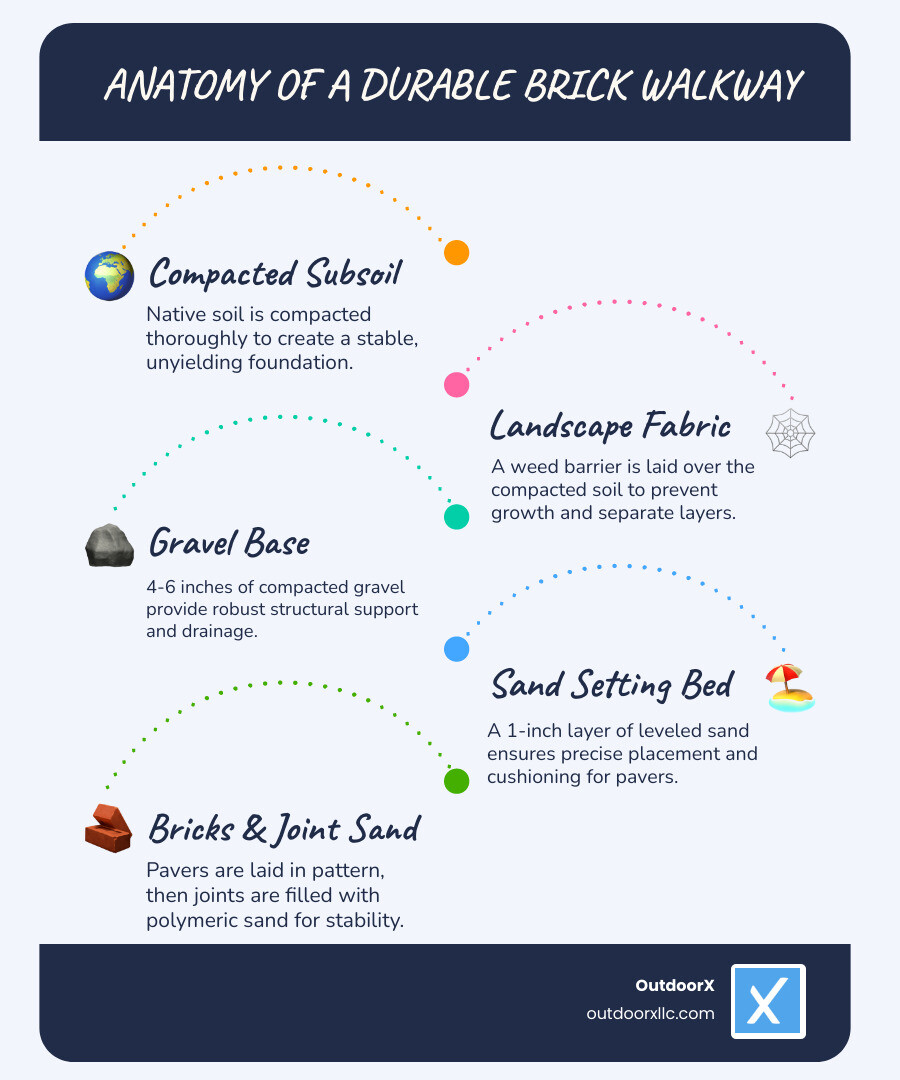
The best way to lay brick walkway involves careful planning, proper base preparation, and attention to detail at every step. Here’s the essential process:
Quick Answer:
- Plan and mark your walkway path with stakes and string
- Excavate 7-9 inches deep for the entire walkway area
- Install landscape fabric over compacted soil for weed prevention
- Add a gravel base of 4-6 inches, compacted in layers
- Level a 1-inch sand bed using screeding boards
- Install edge restraints to prevent spreading
- Lay bricks in your chosen pattern, checking for level
- Fill joints with polymeric sand and compact
A brick walkway transforms your home’s curb appeal while adding lasting value to your property. As one expert noted, “brick walks have been known to last for more than a hundred years” when installed correctly. The key difference between a walkway that lasts decades versus one that fails within years comes down to foundation preparation.
The stakes are higher than you might think. A poorly installed brick walkway becomes a safety hazard with uneven, shifting pavers that create trip risks. More importantly, shortcuts in base preparation often mean starting over completely within a few seasons.
The good news? This is absolutely a DIY-friendly project. Most homeowners can complete a standard walkway in a weekend with the right preparation and tools. A 20-foot walkway typically costs between $200-$300 in materials, making it an affordable way to boost your home’s appeal.
The process requires patience more than advanced skills. Each layer – from the excavated base to the final joint sand – plays a crucial role in creating a walkway that will serve your family for generations.
Best way to lay brick walkway glossary:
Planning Your Perfect Path: Tools, Materials, and Design
Before we even think about digging, thorough planning is paramount. This initial phase sets the stage for a smooth installation and a beautiful, long-lasting brick walkway. We’ll decide on the look, gather our supplies, and get a realistic estimate of time and cost. Think of it as mapping out your trip before you even pack your bags!
Step 1: Choosing Your Bricks and Pattern
The first exciting step is selecting the perfect bricks and design pattern. This choice will define the aesthetic of your walkway and impact the installation process. It’s where your personal style truly shines!
Paving Bricks vs. Common Bricks: Not all bricks are created equal for walkway purposes. Ordinary building bricks (used for walls or fireplaces) are too porous and soft for paving applications. They would quickly crack, crumble, and disintegrate under foot traffic and weather exposure. The best way to lay brick walkway is with bricks specifically designed for paving, often called “pavers.” These are kiln-fired at higher temperatures, making them denser, harder, and more weather-resistant. A standard paver typically measures 3 ¾ x 7 ½ inches and is about 2 ⅛ inches thick. They’re built to last!
Types of Pavers:
When you head to the supplier, you’ll find a few main types of pavers ready for your project:
- Clay Pavers: These are the traditional choice, offering a classic, rustic look. They come in various shades of red, brown, and earthy tones, perfect for that timeless feel.
- Concrete Pavers: Available in a wider array of colors, shapes, and textures than clay, concrete pavers can mimic natural stone or even look like traditional brick. They are incredibly durable and often more uniform in size, which can make installation a bit smoother.
- Reclaimed Bricks: For a truly historic or aged look, reclaimed bricks are a fantastic option. They bring so much character! However, be sure they are indeed old paving bricks and not softer building bricks. A simple test: tap two together. A paver will produce a clear “ring” sound, while a softer brick will make a dull “thud.”
Popular Brick Patterns and Their Characteristics:
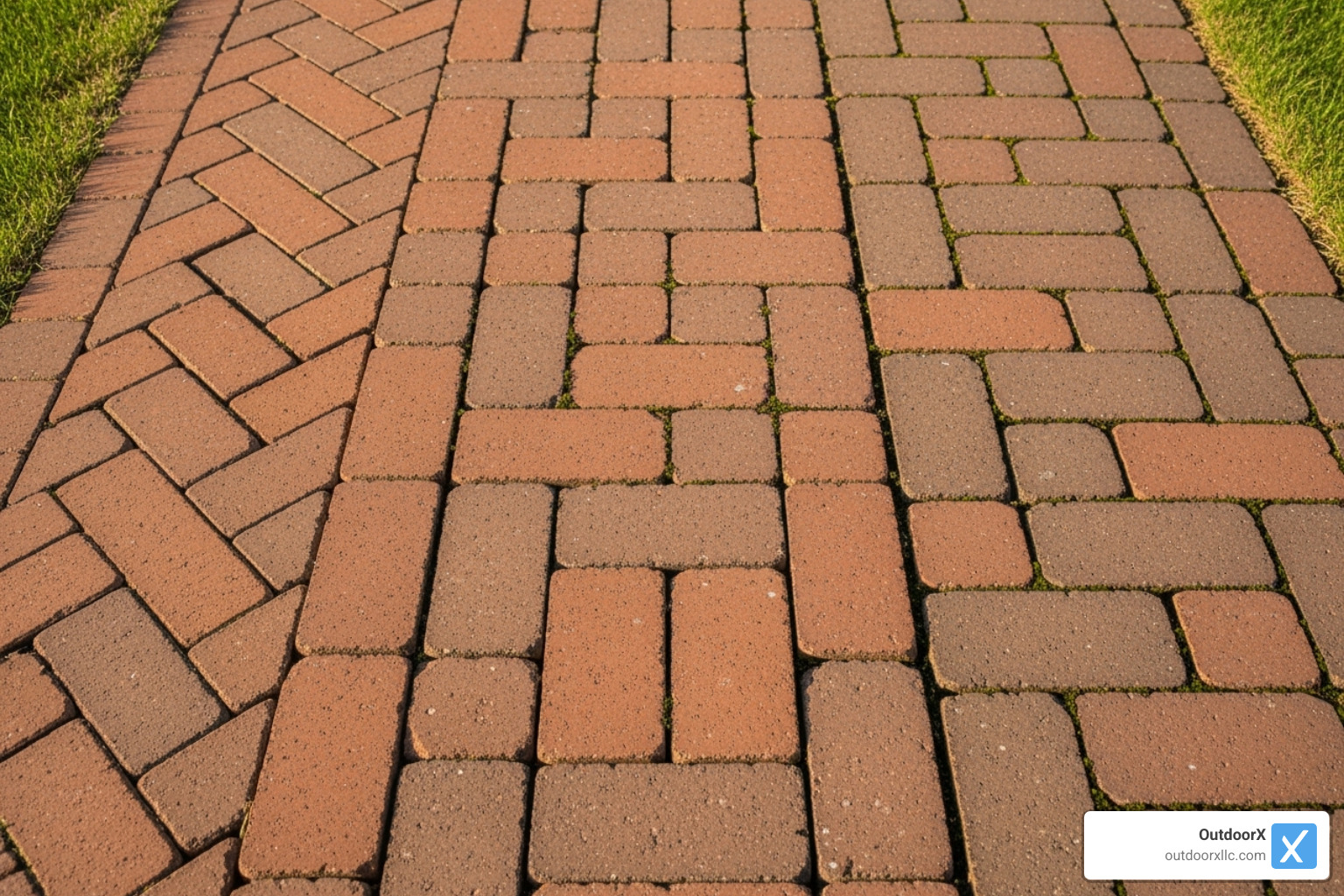
The pattern you choose significantly influences the look and feel of your walkway, as well as the complexity of the installation and the amount of cutting required. For more ideas on creating a custom look, check out this helpful guide: How to Lay a Patterned Brick Paver Walkway for a Custom Look.
- Running Bond: This is arguably the simplest and most common pattern. Bricks are laid in straight lines, with each brick offset by half its length from the bricks in the adjacent rows. It’s easy to install and creates a clean, linear look. It generally requires less cutting than other patterns, making it a great choice for beginners.
- Herringbone: A centuries-old design, the herringbone pattern involves laying bricks at a 45- or 90-degree angle to create a V-shaped or zigzag effect. It’s incredibly strong and stable, making it ideal for areas with heavy use or for preventing shifting. It creates a dynamic visual and is particularly good for curvy paths. However, it typically requires more cutting, especially along the edges.
- Basketweave: This pattern involves laying pairs of bricks side-by-side, alternating their orientation to create a woven appearance. It’s popular for its classic, informal look and is relatively straightforward to install. It can be achieved with minimal cutting if the walkway width is a multiple of the brick dimensions.
- Stack Bond: Bricks are laid directly on top of each other, creating a grid-like pattern. While visually modern and minimalist, this pattern is less stable than others as there’s no interlocking. It’s best suited for areas with very little traffic or when set in mortar.
- Concentric Square: Ideal for larger, open areas or patios, this pattern involves bricks laid in squares, often radiating from a central point. It can be complex to lay but offers a grand, formal appearance.
- Pinwheel: A charming pattern where four bricks surround a central half-brick, resembling a pinwheel. It’s more intricate but adds a unique touch.
Step 2: Gathering Tools and Materials
Having all your tools and materials ready before you start digging will save you immense time and frustration. Imagine getting halfway through and realizing you forgot the tamper! We’ve compiled a comprehensive list based on our experience and industry best practices. Many of the larger tools, like a plate compactor, can be rented from a local equipment supply store, saving you money. For heavy materials like gravel and sand, consider having them delivered to your driveway – it’s a huge back-saver! And remember, safety first: always have your safety gear ready, including gloves, safety glasses, and sturdy work boots.
| Category | Essential Tools | Essential Materials |
|---|---|---|
| Measuring/Marking | Tape Measure, String Line, Stakes, Spray Paint | |
| Digging/Moving | Shovel (flat and pointed), Wheelbarrow | |
| Compacting | Hand Tamper (or Plate Compactor for larger projects) | |
| Leveling | Long Level (4-6 ft), Rubber Mallet, Screeding Boards | |
| Cutting Bricks | Masonry Saw (wet saw, can be rented) or Brick Chisel & Hammer | |
| Other Tools | Utility Knife (for landscape fabric), Push Broom, Garden Hose | |
| Base Materials | Bricks/Pavers, Gravel (paver base), Coarse Sand (concrete sand), Landscape Fabric | |
| Edging/Joints | Edge Restraints (plastic, metal, or brick), Spikes (for edging), Polymeric Sand | |
| Safety Gear | Safety Glasses, Work Gloves, Dust Mask, Sturdy Boots |
Step 3: Calculating Materials and Project Cost
Now that you have your design in mind, let’s figure out how much material you’ll need and what your project might cost. Getting these numbers right upfront prevents frustrating delays and unexpected budget surprises.
First, determine your walkway’s dimensions. Measure the length and width of your planned path in feet. Multiply these two numbers together to get the square footage of your walkway. For example, a walkway that is 20 feet long and 3 feet wide is 60 square feet (20 ft x 3 ft = 60 sq ft). If your walkway isn’t a simple rectangle, you might need to break it down into smaller, measurable sections and add them up. You can use an online tool like this one to help: Calculate your walkway area.
Next, let’s figure out your material quantities:
- Bricks: A good rule of thumb is to estimate about 5 bricks per square foot for standard pavers. So, for a 60 sq ft walkway, you’d need roughly 300 bricks (60 sq ft x 5 bricks/sq ft = 300 bricks).
- Gravel and Sand Volume: This gets a bit trickier, but don’t worry! You’ll need enough gravel for a 4-6 inch base and sand for a 1-inch bed. Most suppliers sell these by the cubic yard. A cubic yard covers about 80 sq ft at 4 inches deep. So, for our 60 sq ft example, you might need about 1 cubic yard of gravel and perhaps half a cubic yard of sand. It’s always best to check with your local supplier, as they can help you calculate based on your specific dimensions and the density of their materials.
Don’t forget the 10% overage! Always add an extra 10% to your material calculations. This accounts for any broken bricks, cutting errors, or slight variations in your measurements. It’s much better to have a few extra bricks than to run out in the middle of your project and have to stop everything to go buy more.
Finally, let’s talk about DIY cost estimates. The cost of a DIY brick walkway can vary widely depending on the type of pavers you choose, local material prices, and whether you rent or own your tools. Generally, you can expect to spend anywhere from $4 to $15 per square foot for materials alone. This includes bricks, gravel, sand, landscape fabric, and edging.
So, our 60 sq ft walkway might cost between $240 and $900 in materials. These are average costs based on general internet data and not actual costs for OutdoorX LLC. Prices can fluctuate significantly based on your location, supplier, and the specific products you select. The good news is that doing it yourself is often significantly more affordable than hiring a professional, making it a truly rewarding project!
